


At five years old, your child is standing on the threshold of a massive developmental leap. This is the "golden age" of curiosity, where the transition from preschool to kindergarten demands tools that challenge their logic, ignite their creativity, and build social resilience. Choosing the best educational toys for 5-year-olds is about more than just fun—it is about architecting their future.
Discover how purposeful play can transform your child's learning journey. Explore our curated Educational Toys Collection and STEM Essentials to start their journey today.
Understanding the 5-Year-Old Mind
By age five, cognitive milestones are moving at lightning speed. Children begin to understand complex instructions, recognize patterns, and develop "theory of mind"—the ability to understand that others have different thoughts and feelings. This is why STEM activities for preschoolers are so effective; they leverage this natural urge to categorize, build, and solve.
Physically, they are mastering fine motor control. The ability to use scissors, draw recognizable shapes, and manipulate small building pieces like LEGO or magnetic tiles is reaching its peak. Mentally, they are ready for open-ended learning that doesn't just give them the answer but asks them to find it.
The Screen-Time Trap: Why Hands-On Learning Wins
In a world dominated by digital distractions, the temptation to rely on tablets is high. However, passive consumption—where a child simply watches a screen—fails to build the neural connections required for spatial reasoning and social empathy. Truly creative educational toys require a child to be the source of the action. When a child builds a tower that falls, they learn physics; when an app does it for them, they only learn to wait.
The Active Discovery Framework
To spark genius, we focus on three pillars: technical logic, linguistic foundation, and imaginative empathy.
STEM & Logic
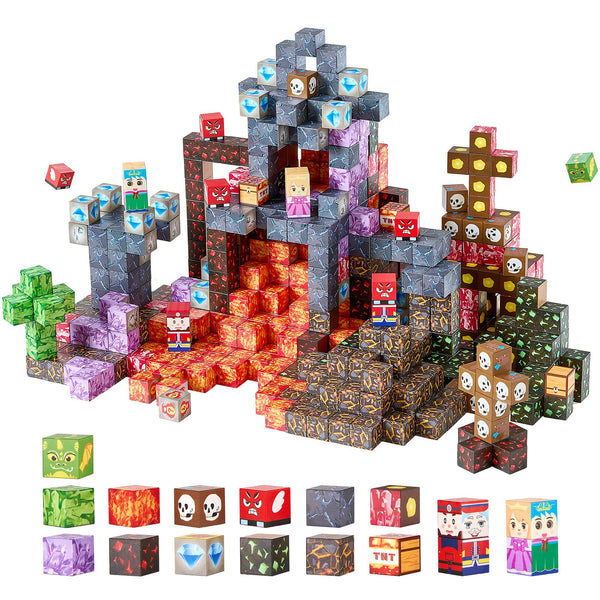
Introduce engineering through building sets. Magnetic tiles and blocks teach geometry, balance, and the "why" behind how things stand up.
Literacy & Spelling
Letter recognition games turn phonics into a puzzle. These toys bridge the gap between "seeing" a letter and "knowing" its sound.
Shop Literacy ToolsImaginative Empathy
Role-playing sets allow children to try on different personalities. Playing "doctor" or "hero" builds emotional intelligence and social cooperation.
Mastering the Kindergarten Fundamentals
At age five, math is no longer just about counting to ten; it's about mathematical thinking. Using Mathlink cubes or counting dice helps children visualize numbers as physical quantities. They begin to understand that "addition" is simply putting two piles of blocks together.
Similarly, language development shifts from simple speaking to early reading. Storytelling toys and See-and-Spell boards provide the tactile feedback that brains need to map abstract symbols (letters) to concrete concepts (words).
Frequently Asked Questions (30 Essential Answers)
1. What are the best educational toys for 5-year-olds?
Building sets (Magna-Tiles), STEM kits, literacy games (See & Spell), and role-play costumes are the top choices for balanced development.
2. How do STEM toys help preschoolers?
They foster critical thinking and spatial logic by allowing kids to physically manipulate concepts like gravity, magnetic force, and structural balance.
3. Are magnetic tiles safe for 5-year-olds?
Yes, most high-quality magnetic tiles are designed with reinforced plastic and securely encased magnets for child safety.
4. Can toys improve my child's attention span?
Open-ended building toys and complex puzzles require sustained focus to complete, which naturally strengthens a child's ability to concentrate.
5. What is "open-ended learning"?
It is play where there is no single "right" way to use the toy, such as blocks or art supplies, allowing the child's imagination to lead the activity.
6. Do 5-year-olds need coding toys?
"Pre-coding" toys like the Code-a-pillar teach logical sequencing (If/Then logic) without requiring a screen, which is excellent for brain development.
7. How do I choose toys that won't be outgrown quickly?
Look for "growth toys"—those with multiple levels of challenge or that can be combined with other sets, like LEGO or marble runs.
8. Why is imaginative play important for social skills?
It allows children to practice conflict resolution, empathy, and conversation in a safe, simulated environment.
9. What toys are best for fine motor skills?
Beading kits, clay modeling (Play-Doh), and small interlocking blocks are perfect for strengthening finger dexterity.
10. Are digital tablets educational for 5-year-olds?
When used with high-quality apps like Osmo, they combine physical movement with digital learning, providing a balanced experience.
11. How does role-play build empathy?
By acting as someone else (a teacher, a vet), kids learn to consider others' perspectives.
12. What are the best math toys?
MathLink cubes and number balance scales are the best for visualizing arithmetic.
13. Is it better to buy fewer, higher-quality toys?
Yes. Durable, high-utility toys prevent "overchoice" and encourage deeper play.
14. What are good outdoor educational toys?
Stomp rockets and bug catching kits encourage physical exercise and biological observation.
15. Do puzzles help with problem solving?
Puzzles teach persistence, pattern recognition, and spatial logic.
16. Are wooden toys better than plastic?
Wooden toys are often more sustainable and provide a different tactile sensory experience.
17. What age should I start STEM toys?
Simple STEM concepts can start at age 3, but age 5 is when they can handle complex builds.
18. How can I organize an educational playroom?
Use low shelves and rotate toys monthly to keep interest high and clutter low.
19. Can toys help with speech delays?
Interactive storytelling toys and role-play encourage vocalization and vocabulary building.
20. What are the top art kits for 5-year-olds?
Crayola sets and mess-free drawing pads are the most popular for this age.
21. Why is 5 a critical age for literacy toys?
It is the primary window for phonological awareness before reading fluency begins.
22. Do music toys help with math?
Yes, rhythm and patterns in music are directly related to mathematical sequences.
23. What is a "Montessori" toy?
A toy that is simple, made of natural materials, and isolates one specific skill for mastery.
24. Can coding toys be screen-free?
Yes, mechanical coding sets use buttons or tiles to input commands.
25. How to identify high-quality plastic toys?
Look for "BPA-free" and "High-grade ABS" plastics that don't crack easily.
26. Do strategy games help with patience?
Yes, games like Zingo or Bingo require kids to wait for their turn and plan ahead.
27. Are science kits too messy?
"Dry" science kits like magnets or geodes are very clean and highly educational.
28. Can toys teach biology at age 5?
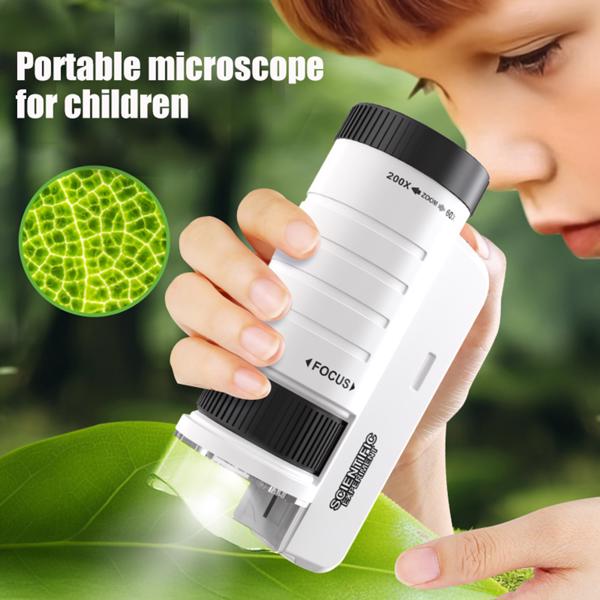
Bug habitats and magnifying glasses are the best introduction to biological observation.
29. What are the best geography toys?
Puzzle maps and talking globes help children visualize the scale of the world.
30. Where can I find a curated selection of these toys?
You can browse expert-vetted options at WonderKidsToy.
Invest in Their Most Critical Years
Every choice you make in your child's toy selection is a building block for their brain. Give them the tools to solve, create, and innovate. Discover the full collection at WonderKidsToy today.
Browse the Expert-Vetted Collection


