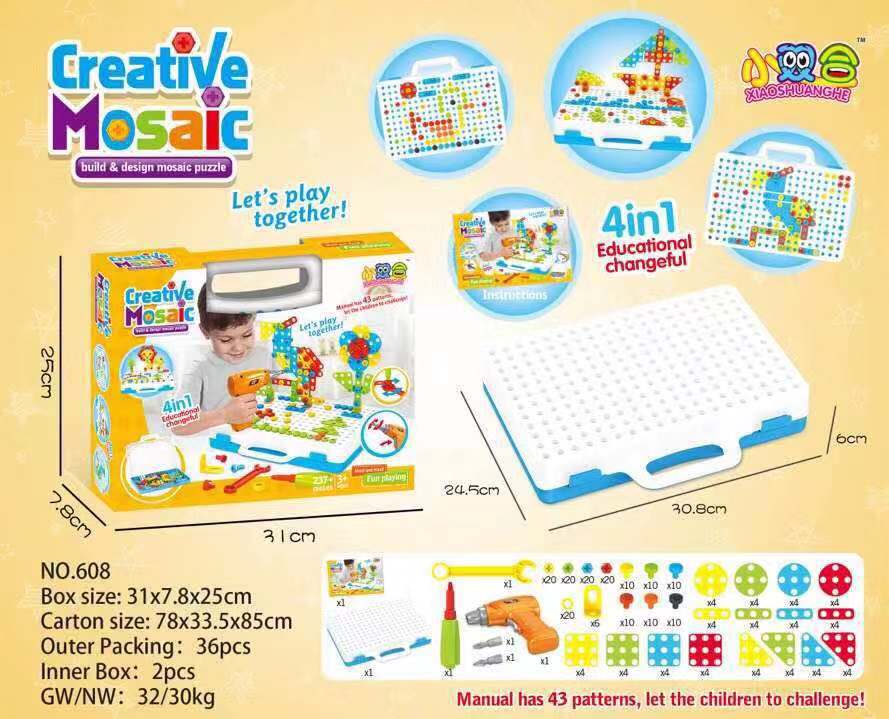
DRILL-AND-BUILD ACTIVITY SETA Hands-On Building Board with 18 Package Choices for Different Project Sizes
This drill building kit gives children a practical way to arrange pieces on a board, secure them with the appropriate tool and take the design apart when they are ready to build again. The activity can move between copying a picture, making a pattern and creating a completely original design.
The product has 18 available package choices, including single sets, larger multi-set bundles, English-guide options and one electric-screwdriver-only accessory. The piece count and included items are not identical, so the complete option name matters more than the general product photo.
The listing identifies the main activity as a tabletop construction project. Families should check the age guidance, exact contents, battery information and smallest-piece warning on the selected package before play.
18 Package Choices
The available options range from a screwdriver-only accessory to multi-set building packages.
106 to 252 Pieces
Single-set names include several different listed piece counts.
Guide and Packaging Differences
Some choices mention an English guide, color box or no color box.
Adult Setup Matters
Small pieces and a powered tool require careful counting, battery handling and supervision.
What Families Can Expect
The central play idea is easy to understand: choose pieces, place them on the board and use the matching fastener or tool when the chosen set includes it. Children can follow a visible design or decide where each shape and color belongs in their own picture.
A drill-and-build board can be especially appealing to children who enjoy taking things apart and rebuilding them. The design does not have to remain finished. Returning the pieces to storage and starting again is part of the value.
The activity may offer practice with controlled hand movements, visual matching, planning and persistence. Those are opportunities created by play, not guaranteed developmental results. The child’s age, interest, instructions and adult support will shape the experience.
Some package names describe more than one complete set, while one option contains only the electric screwdriver. Parents should treat each choice as a separate configuration rather than assuming every order includes the same board, pieces, guide and tool.
Choosing the Right One of 18 Options
Start by deciding whether the family needs one complete set, a multi-set bundle or only a replacement-style screwdriver. Then compare piece count, guide language and packaging wording.
The listed counts describe the named package, but a full item-by-item breakdown should still be checked against the corresponding image and packing list. A larger number may include boards, connectors, fasteners, tools or other parts rather than only decorative pieces.
252-Piece Starter Set
2 × 251-Piece Sets
3 × 251-Piece Sets
193-Piece Set – Color Box
223-Piece Set – Color Box
224-Piece Set – Color Box
Electric Screwdriver Only
237-Piece English Guide Set + Screwdriver
2 × 151-Piece Sets – Color Box
237-Piece English Guide Set
151-Piece Set – Color Box
237-Piece Set
106-Piece Set
151-Piece Set – No Color Box
2 × 237-Piece Sets
3 × 151-Piece Sets – Color Box
251-Piece Set
2 × 237-Piece English Guide Sets
A Calm First Building Session
Open the selected package with an adult and separate the board, fasteners, decorative pieces, guide and tool. Count loose components before they spread across the room. Keep packaging nearby until the selected configuration is confirmed.
Begin with a small design. A short row, simple shape or two-color pattern helps the child understand how the pieces sit on the board and how the tool should be held. There is no need to use the full piece count during the first session.
When a powered screwdriver is included, an adult should manage batteries and demonstrate gentle use. The child should stop pressing when the fastener is secure. Continued force can damage the board, tool or fastener.
Let the child choose whether to copy a guide picture or invent something new. Correct only unsafe tool use or a connection that may damage the parts. A design that looks different from the sample can still be a successful build.
Ways to Play Beyond One Finished Picture
Color pattern
Create a repeating sequence and invite the child to continue it.
Picture copy
Choose one simple guide image and find the matching pieces together.
Free design
Build a vehicle, animal, flower or abstract picture from imagination.
Mirror challenge
Place a design on one side and recreate it in reverse on the other.
Limited-piece build
Use only ten or twenty pieces and see what can be made.
Parent-child turns
Alternate choosing a piece and deciding where it belongs.
Take-apart plan
Remove pieces in an agreed order and sort them as they come off.
Story board
Turn the finished pattern into the setting for a short pretend story.
Helping the Activity Grow with the Child
A younger or newer builder may need the board prepared with only a few pieces and one adult-guided tool. A more experienced builder may enjoy planning a larger picture, checking symmetry or working from an English guide.
Instead of measuring success by speed, notice how the child responds when a piece does not fit. Looking again, turning the piece or choosing another location can be more valuable than finishing quickly.
Multi-set options may support siblings or separate work areas, but the number of children who can play safely depends on the available tools, space and supervision. More pieces do not automatically make the activity easier to share.
Keep some designs temporary. Photograph a favorite build before taking it apart so the board remains available for new ideas. This can reduce the feeling that every successful picture must be kept forever.
Tools, Batteries and Package Differences
The listing includes an electric-screwdriver-only option and several packages that mention a screwdriver. Do not assume the tool is included when the option name does not say so. Compare the selected image and packing list.
The existing product information states that the powered tool uses two AA batteries and that batteries are not included. The family should still confirm the exact battery requirement on the delivered instructions before installation.
Only an adult should open the battery compartment, install or replace batteries and check the screw. Remove batteries during long storage when the instructions recommend it, and never mix battery types or old and new batteries.
English-guide wording appears in several variant names. Other packages may use a different guide or no printed guide. The absence of an English label does not confirm what language will be supplied.
Storage, Cleanup and Missing-Piece Prevention
Choose a lidded container or divided organizer that keeps the board, tool, fasteners and decorative pieces together. Multi-set bundles may need separate bags so the family can tell which pieces belong to each board.
End play with a simple count or sorting routine. Fasteners can be grouped by type and colored pieces by shade. This turns cleanup into part of the activity while making missing parts easier to notice.
Keep the screwdriver and batteries under adult control. Do not leave the tool in a child’s bed, travel seat or unsupervised play area.
Inspect the board holes, fasteners and tool tip regularly. Stop use when a piece cracks, a fastener no longer holds securely or the tool casing or battery compartment is damaged.
Building-Kit Safety
- Follow the age guidance and small-parts warning on the exact selected package.
- Have an adult manage batteries, the battery compartment and any powered tool setup.
- Use the screwdriver only on the included fasteners and keep it away from faces, hair, clothing and household screws.
- Do not force fasteners after they are secure or use damaged pieces.
- Count loose components before and after play and keep them away from younger children and pets.
- Build on a stable table or floor area away from food, drinks, stairs and walkways.
- Stop use if the tool becomes hot, the battery area changes shape or a piece exposes a sharp edge.
- One option is a screwdriver only and should not be mistaken for a complete activity set.
Who May Enjoy This Type of Building
This set may suit a child who likes patterns, construction, tools and projects that can be rebuilt. It may be less suitable for a child who still mouths small parts or uses a powered tool roughly.
A smaller package can feel more manageable for a first experience, while a larger or multi-set choice may fit a family that already knows the activity will be used regularly. The best choice depends on the contents and the child, not simply the largest number.
Parents looking for an official Montessori classroom material should note that this is a Montessori-inspired commercial activity kit. Its board, fasteners and powered tool are different from traditional Montessori materials.
Use it as one option in a varied play routine alongside art, books, open blocks, outdoor movement and conversation. The kit does not need to become a formal lesson to be worthwhile.
What to Check When the Order Arrives
- Confirm the full option name, piece count and whether it is a single set, multi-set bundle or screwdriver only.
- Compare the board, tool, guide, packaging and loose components with the selected image.
- Count the major contents before discarding the box.
- Read the age guidance, battery requirement and small-parts warning.
- Check whether an English guide and electric screwdriver are included in the selected package.
- Inspect the board, fasteners, tool tip, casing and battery compartment for damage.
- Keep the packaging until the configuration and condition are confirmed.
The option named Electric Screwdriver Only is not a complete building kitSelect that choice only when the family intentionally needs the tool by itself. For a full activity, choose a package whose name and image show the board, pieces and intended accessories.
Commonly Asked Questions by Parents
How many package choices are available?
There are 18 available options, including single sets, multi-set bundles, English-guide configurations and one screwdriver-only accessory.
What is the smallest listed complete set?
The smallest complete-set name is the 106-Piece Set. The Electric Screwdriver Only option is not a complete set.
What is the largest single-set count?
The largest single-set name is the 252-Piece Starter Set, although the exact item breakdown should be checked.
Are multi-set bundles available?
Yes. Several options list two or three sets.
Does every set include an electric screwdriver?
No. Inclusion varies by option, and one choice is the screwdriver only.
Are batteries included?
The existing listing states that two AA batteries are required for the powered tool and are not included. Confirm this on the delivered instructions.
Is an English guide included?
Only some option names specifically mention an English guide.
Are all piece counts directly comparable?
Not necessarily. Counts may include different combinations of pieces, fasteners, boards or accessories.
What age is the kit for?
The exact age range should be taken from the selected package and its small-parts warning.
Is it an official Montessori material?
No official classroom certification is stated. It is a Montessori-inspired drill-and-build activity.
Can siblings share one set?
They can take turns when the space, tool count and supervision allow safe sharing.
Can the child use a household screwdriver?
Use only the tool and method approved for the product. Household tools may damage parts or create safety risks.
How should the pieces be stored?
Use a secure divided container and keep the powered tool and batteries under adult control.
What should I do with a cracked fastener?
Remove it from use immediately and check the surrounding pieces for damage.
Can the kit guarantee better fine-motor skills?
No. It may offer practice opportunities, but no developmental result is guaranteed.
Choose the Piece Count, Guide and Tool Combination Carefully
Compare all 18 options and select a complete package that matches the family’s project size, storage space and supervision plan.
Review the Drill Building Kit Options