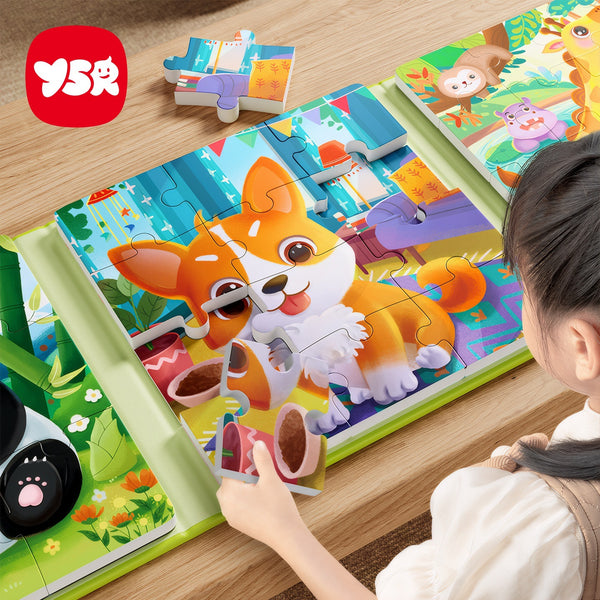
A child working on a puzzle is engaged in one of the most neurologically rich activities available in childhood play. Every piece placed requires spatial reasoning, visual pattern recognition, fine motor precision, and the persistence to hold a complex goal in mind while executing hundreds of sequential sub-tasks. Unlike most digital entertainment that stimulates passively, a puzzle demands active, effortful engagement — exactly the kind of cognitive work that builds lasting capability. Puzzle toys for kids are among the most consistently recommended educational toys by child development specialists, occupational therapists, and early childhood educators precisely because they deliver all of these benefits simultaneously, at any age, through an activity that children find genuinely compelling.
The puzzle toy category has expanded dramatically in recent years, encompassing everything from soft fabric puzzles for infants to 3D spatial challenges for teenagers. Choosing the right puzzle for a child’s current developmental level — challenging enough to require real effort, accessible enough to allow genuine success — is the key to maximising the developmental return on what is already one of the most effective educational toy investments available. Explore our complete collection of puzzles and brain teasers for children of all ages to see the full range of challenge-rich puzzle experiences we carry.
In this complete guide, we cover what makes puzzle toys genuinely developmental, the best types for different ages and skill levels, our top picks for 2026, and practical guidance for parents who want to use puzzle play to build their child’s cognitive capabilities as effectively as possible.
Table of Contents
Why Puzzle Toys Are Among the Most Developmentally Powerful Toys Available to Children
Puzzle toys have a developmental profile that is genuinely exceptional. They develop spatial reasoning — the ability to mentally rotate, manipulate, and reason about objects in space — which research from the University of Chicago and multiple other institutions identifies as a strong independent predictor of mathematics, science, and engineering performance. They develop fine motor precision through the exact placement of pieces. They develop working memory through the requirement to hold the overall goal and partial progress in mind while attending to individual pieces. And they develop productive persistence — the willingness to continue working through a challenge after initial failure — more directly than almost any other play activity.
What makes puzzles particularly valuable is the quality of feedback they provide. Unlike digital games that offer partial credit, encouragement, and hints, a physical puzzle piece either fits or it does not. This binary, unambiguous feedback creates a tight learning loop: the child attempts a placement, receives clear information about whether it was correct, and adjusts accordingly. There are no hints. There is no partial credit. Success is real and entirely the child’s own. That unambiguous success — the moment the last piece clicks into place — is one of the most satisfying experiences in all of children’s play, and it creates the intrinsic motivation to attempt the next, more challenging puzzle.
Puzzles also have the remarkable property of scaling naturally with the child. Every child starts with simple puzzles. Every child eventually finds them trivial and seeks more difficult ones. The puzzle category provides continuous, appropriate challenge from the first shapes a toddler sorts to the complex three-dimensional mechanical puzzles that challenge adults. No other toy category offers this continuous developmental arc across such a wide age range.
Skills Children Build Through Puzzle Toy Play
Spatial Reasoning
Mentally rotating pieces, identifying where shapes fit, and understanding how parts relate to the whole. Research consistently identifies spatial reasoning as a predictor of maths, science, and engineering performance.
Visual Pattern Recognition
Identifying shapes, colours, and patterns that indicate where pieces belong. Pattern recognition is foundational to reading, mathematics, and the scientific identification of regularities in data.
Fine Motor Development
Picking up, rotating, and precisely placing small pieces develops the finger dexterity and hand-eye coordination that supports writing, drawing, and the tool use required in most technical professions.
Working Memory
Holding the target image and partial progress in mind while attending to each individual piece exercises working memory — the cognitive workspace that supports all complex learning and problem-solving.
Productive Persistence
Every puzzle requires sustained effort through initial failure. The habit of trying multiple approaches, maintaining focus, and persisting to completion is one of the most valuable learning orientations available to children.
Logical Deduction
Using known information (a piece’s shape, colour, and position relative to completed sections) to eliminate impossible placements and narrow down correct ones. This logical elimination is the foundation of systematic problem-solving.
The Best Types of Puzzle Toys for Kids
1. Wooden Shape and Peg Puzzles (Ages 6 months–3 years)
Simple wooden peg puzzles — where each piece is a distinct shape that fits into a matching hole — are the first puzzle experience for babies and toddlers. Each piece has a knob for easy grasping, the images are simple and vivid, and success is immediate and unambiguous. These puzzles introduce the foundational concepts of shape matching, spatial fitting, and cause-and-effect simultaneously. For children 6 to 18 months, simple single-piece inset puzzles (a circle fits in the circle hole) are appropriate. From 18 months, multi-piece peg puzzles with 3 to 6 pieces develop these skills further.
2. Chunky Floor Puzzles (Ages 18 months–5 years)
Large-piece floor puzzles with 4 to 24 pieces are ideal for toddlers and preschoolers. The large pieces are safe and easy to grasp, the physical scale of the completed puzzle creates a satisfying visual impact, and the process of building something large on the floor is inherently engaging. The best floor puzzles have clear, vivid imagery that motivates completion and provides enough visual information for colour-matching alongside shape-fitting. World map floor puzzles additionally build geographic knowledge alongside spatial skills.
3. Standard Jigsaw Puzzles (Ages 3–12 years)
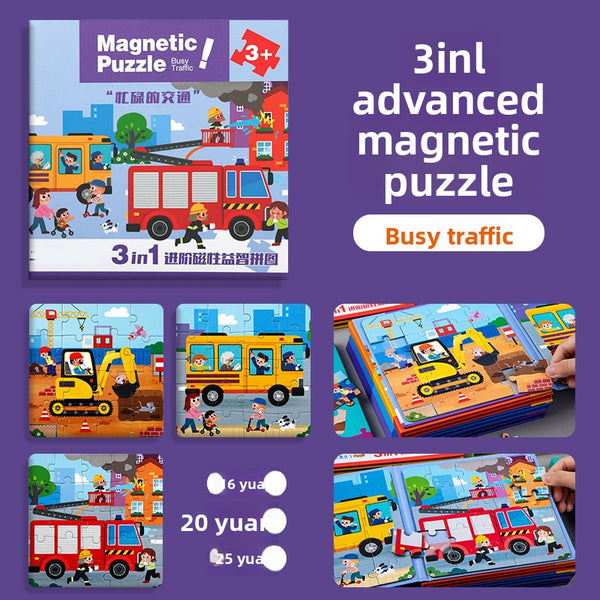
Traditional jigsaw puzzles are the broadest and most scalable puzzle category. Piece counts range from 12 for young preschoolers to 1,000-plus for older children and adults. The key to maximising developmental value is piece count progression: starting with 12 to 24 pieces for ages 3 to 4, progressing through 50 to 100 pieces at ages 5 to 6, 100 to 300 pieces at ages 7 to 9, and 300 to 1,000 pieces at ages 10 and above. Images matter enormously for motivation: puzzles featuring themes the child loves — animals, maps, space, favourite films — sustain engagement far more effectively than generic images.
4. 3D and Architectural Puzzles (Ages 7‑16 years)
Three-dimensional puzzles — foam block structures, interlocking wooden or plastic models, mechanical 3D puzzles, and architectural model kits — add an additional spatial dimension that flat jigsaw puzzles cannot provide. Building a three-dimensional structure from interlocking pieces requires understanding spatial relationships in all three dimensions, planning the assembly sequence, and developing structural intuition about which pieces must be placed before others. These challenges build the spatial intelligence that directly supports engineering, architecture, and scientific visualisation.
5. Logic and Single-Player Puzzle Games (Ages 5‑16 years)
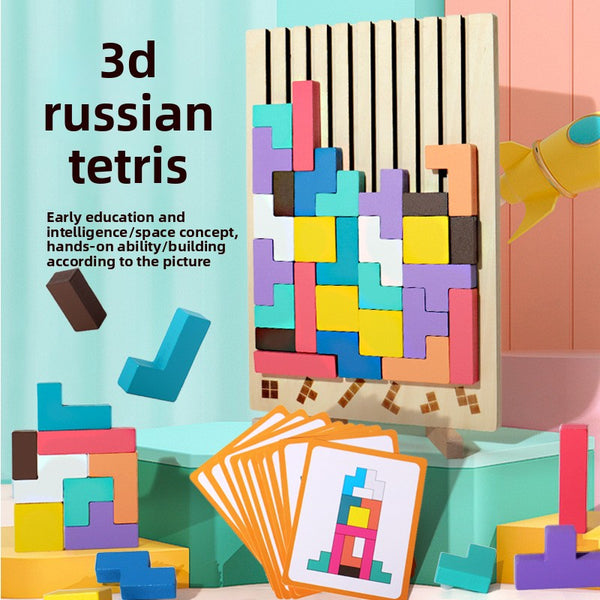
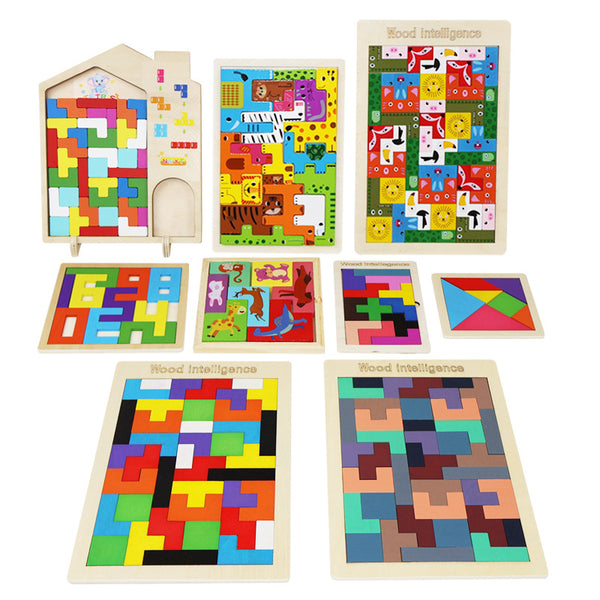
Logic puzzle games — ThinkFun Rush Hour, Gravity Maze, Kanoodle, tangram sets, and pentomino puzzles — build logical reasoning and spatial deduction alongside the pattern recognition of traditional jigsaw puzzles. These are distinct from jigsaw puzzles because each challenge requires strategic reasoning rather than visual matching — the child must figure out which pieces go where through logical elimination rather than visual similarity. They provide dozens to hundreds of unique challenges from a single purchase, making them among the highest-value puzzle investments available.
6. Maze and Labyrinth Puzzles (Ages 4‑14 years)
Maze toys and labyrinth puzzles — from simple 2D cardboard mazes for young children to the Perplexus three-dimensional maze ball for older children and teenagers — build spatial navigation, planning, and fine motor control simultaneously. The physical challenge of guiding an object through a maze without a reset button (or with a reset — start over from the beginning) builds persistence alongside spatial reasoning. Mazes are among the few puzzle types that also develop physical coordination alongside cognitive skills.
Best Puzzle Toys for Kids in 2026 (Ranked)
1. Melissa and Doug Wooden Peg Puzzles — Best for Babies and Toddlers
Age: 12 months–3 years | Pieces: 5–8 per puzzle | Price: ~$10–$15 each
Melissa and Doug wooden peg puzzles are the gold standard in first puzzles for babies and toddlers. Each piece features a wooden knob for easy grasping by small fingers, bright illustrations that provide clear visual cues for placement, and recessed puzzle boards that make the target position obvious. The solid wood construction provides durability for enthusiastic toddler use. Themes range from farm animals and vehicles to alphabets and numbers, providing simultaneous vocabulary development alongside spatial reasoning. Best for: Babies aged 12 months and above taking their first steps into puzzle play.
2. Melissa and Doug World Map Floor Puzzle — Best Educational Floor Puzzle
Age: 4–10 years | Pieces: 33 | Price: ~$20–$30
This 24 x 36-inch floor puzzle delivers both spatial reasoning development and genuine geographic education simultaneously. Large enough to be satisfyingly immersive, manageable enough for children aged 4 to 10 to complete independently. Each continent and region is illustrated with country names, capitals, and wildlife. Assembling the world map builds the spatial memory of how continents relate to each other in a way that no flat map study can replicate. Best for: Families wanting puzzle play that builds both spatial skills and world geography knowledge together.
3. Ravensburger Jigsaw Puzzles — Best Quality Jigsaw Series
Age: 3‑16 years | Pieces: 12 to 1,000+ | Price: ~$10–$35 depending on size
Ravensburger is the most consistently recommended jigsaw puzzle brand for children and the standard against which all others are measured. Their Softclick technology ensures pieces fit together with a satisfying, unambiguous click that makes correct placements immediately evident — critical for building the confidence of young puzzlers. Pieces are cut from thick, premium blue board that prevents bending and provides tactile satisfaction. The range of piece counts (12, 24, 35, 48, 60, 100, 200, 300, 500, 750, 1000) creates a perfect developmental ladder from toddler to teenager. Best for: Families who want the highest quality jigsaw puzzle experience at every age and piece count level.
4. ThinkFun Rush Hour — Best Logic Puzzle Game
Age: 8‑14 years | Challenges: 40 cards, 4 difficulty levels | Price: ~$25–$35
Rush Hour is the gold standard in logic puzzle games for children — a traffic jam puzzle where the child must move blocking vehicles to free the red car from the grid. Forty unique challenge cards across four difficulty levels ensure the puzzle remains appropriately challenging as skills develop. Unlike jigsaw puzzles, Rush Hour builds constraint reasoning — working backward from desired outcomes, eliminating impossible moves, and planning multiple steps ahead. It is one of the most cognitively demanding single-player puzzle games available for the 8 to 14 age range. Best for: Children aged 8 to 14 who want the most challenging logic puzzle experience available.
5. Perplexus Original Maze Ball — Best Spatial Maze Puzzle
Age: 6‑16 years | Obstacles: 70+ sequential | Price: ~$20–$30
Perplexus is a clear sphere containing a complex three-dimensional maze track with 70-plus sequential obstacles. Rotating and tilting the sphere guides a marble through the track — and failure at any obstacle means starting over from obstacle one. This reset consequence builds genuine persistence and the specific spatial intelligence of three-dimensional navigation. Multiple versions — Original, Warp, Epic, Beast — provide escalating challenge levels from age 6 through adult. Best for: Children aged 6 and above who want a physical, spatial puzzle challenge with the persistence-building consequence of starting over.
6. Tangram Set — Best Classic Spatial Puzzle
Age: 5‑14 years | Type: Seven-piece geometric dissection puzzle | Price: ~$10–$20
Tangrams are ancient Chinese dissection puzzles consisting of seven geometric pieces that can be combined to form hundreds of different silhouette shapes. Recreating a given shape from the seven tans requires sophisticated spatial reasoning, trial-and-error persistence, and geometric intuition that research consistently links to mathematical ability. Quality wooden or magnetic tangram sets with hundreds of challenge cards provide excellent value. The simplicity of the puzzle — seven pieces, infinite challenges — makes tangrams one of the most elegant spatial intelligence tools available. Best for: Children aged 5 to 14 building spatial reasoning and geometric intuition through one of the most time-tested puzzle formats available.
7. Kanoodle — Best Pocket Logic Puzzle
Age: 7‑14 years | Challenges: 200+ | Price: ~$10–$15
Kanoodle is a pocket-sized logic puzzle that packs extraordinary problem-solving depth into a tiny package. Twelve coloured pentomino pieces must be fitted into a small tray, with 200-plus challenge cards presenting incomplete trays requiring the correct remaining pieces. The spatial reasoning, logical elimination, and persistence required for the hardest configurations is substantial. At $10 to $15, Kanoodle delivers more cognitive challenge per dollar than almost any other toy. Best for: Children aged 7 to 14 wanting a portable, anytime puzzle that fits in a bag and provides genuine cognitive challenge.
8. GraviTrax Marble Run System — Best Construction Puzzle
Age: 8‑14 years | Type: Physical cause-and-effect puzzle system | Price: ~$50–$100 for starter set
GraviTrax bridges the categories of puzzle and construction toy by presenting a physical problem — build a marble run that successfully guides a marble from start to target — and requiring spatial and engineering reasoning to solve it. Unlike traditional marble runs where the goal is aesthetic, GraviTrax provides specific puzzle challenges with defined start and end points. The engineering problem of routing a marble through gravity-driven channels is genuinely complex and provides a progression of challenge from simple to deeply sophisticated. Best for: Children aged 8 to 14 who want physics-based puzzle challenges that combine spatial reasoning with engineering design thinking.
9. Osmo Tangram — Best Digital + Physical Puzzle
Age: 5–10 years | Type: Camera-based tangram challenges | Price: ~$50–$80 including base kit
Osmo Tangram uses a camera attachment on a tablet to recognise real tangram pieces placed in front of the screen and map them onto digital puzzle challenges. The combination of physical piece manipulation with digital feedback and progressive challenge levels builds spatial reasoning through hundreds of unique configurations. Osmo’s technology bridges the physical richness of manipulating real tangram pieces with the motivational structure of a digital game — providing the best of both for children who are comfortable with tablet interfaces. Best for: Children aged 5 to 10 who benefit from structured digital feedback alongside the tactile spatial manipulation of physical pieces.
10. Melissa and Doug See and Spell Puzzle — Best Literacy Puzzle
Age: 4–8 years | Words: 60 words across 8 boards | Price: ~$20–$28
The See and Spell puzzle builds literacy alongside spatial reasoning by requiring children to match individual letter tiles to complete picture words on double-sided boards. Each board combines the picture-matching element of standard puzzles with the letter-sound recognition of phonics learning. Children who use this puzzle regularly develop early spelling skills and phonemic awareness alongside the fine motor and spatial skills that all puzzles build. Best for: Children aged 4 to 8 who benefit from puzzle play that simultaneously builds foundational reading and spelling skills.
11. Wooden Brain Teasers and Interlocking Puzzles — Best for Teen Challengers
Age: 10‑16 years | Type: Interlocking 3D wooden disassembly puzzles | Price: ~$10–$25 per puzzle
Interlocking wooden brain teasers — puzzles consisting of multiple identical or similar pieces that lock together in a specific configuration and must be disassembled and reassembled — provide some of the most sophisticated spatial reasoning challenges available in puzzle form. Understanding how three-dimensional pieces interlock requires genuine three-dimensional spatial visualisation that tests the spatial reasoning of adults as well as teenagers. These puzzles make excellent gifts for children who have mastered all other puzzle types and need genuinely new spatial challenges. Best for: Children aged 10 and above who want the most challenging spatial puzzle experience available without electronic components.
12. Ravensburger 3D Puzzle Buildings — Best 3D Architectural Puzzle
Age: 8‑16 years | Type: Interlocking foam 3D architectural models | Price: ~$20–$50 depending on model
Ravensburger’s 3D building puzzles — the Eiffel Tower, Empire State Building, Colosseum, and dozens of other architectural models — use interlocking foam pieces to construct three-dimensional structures from flat pieces. The assembly process requires understanding how flat pieces translate into curved, three-dimensional forms — one of the most cognitively demanding forms of spatial reasoning available in puzzle format. The completed models are impressive, displayable achievements that build a child’s sense of creative accomplishment alongside the spatial skills the process develops. Best for: Children aged 8 and above interested in architecture, geography, and the challenge of three-dimensional construction from flat components.
Quick Comparison: Best Puzzle Toys for Kids
M&D Peg Puzzles
Type: Wooden peg
Age: 12 months–3 years
Price: ~$10–$15
World Map Floor
Type: Floor jigsaw
Age: 4–10 years
Price: ~$20–$30
Ravensburger Jigsaw
Type: Premium jigsaw
Age: 3–16 years
Price: ~$10–$35
ThinkFun Rush Hour
Type: Logic puzzle game
Age: 8‑14 years
Price: ~$25–$35
Perplexus Ball
Type: 3D maze ball
Age: 6‑16 years
Price: ~$20–$30
Tangram Set
Type: Geometric dissection
Age: 5‑14 years
Price: ~$10–$20
Kanoodle
Type: Pentomino logic
Age: 7‑14 years
Price: ~$10–$15
GraviTrax
Type: Construction puzzle
Age: 8‑14 years
Price: ~$50–$100
See and Spell
Type: Literacy puzzle
Age: 4–8 years
Price: ~$20–$28
3D Ravensburger
Type: 3D architectural
Age: 8‑16 years
Price: ~$20–$50
Best Puzzle Toys by Age: A Complete Developmental Guide
Ages 6–18 Months: First Shape and Space Exploration
First puzzle experiences should be single-piece or very simple shape inset puzzles with large, easy-to-grip knobs. The developmental goal at this stage is introducing the concept that shapes have defined spaces they fit into — laying the spatial foundation for all future puzzle work. Simple shape sorters serve as first puzzles at this age. Single-piece peg puzzles of animals, vehicles, or familiar objects are ideal from 12 months. Success should be easy and frequent; the goal is building the association between puzzle play and the pleasure of successful placement.
Ages 18 Months–3 Years: Multi-Piece Knobbed Puzzles
From 18 months, children are ready for 4 to 8-piece knobbed puzzles covering themes they know and love — farm animals, vehicles, wild animals, food. The challenge of placing multiple pieces in different positions develops spatial reasoning and the persistence to work through several sequential placements. Frame puzzles that outline each piece’s space are more accessible than borderless puzzles; the clear frame guides placement and provides immediate visual feedback. By age 3, most children can manage 12 to 16-piece puzzles at this format.
Ages 3–6: Floor Puzzles and First Jigsaws
Three to six is the prime window for floor puzzles (24 to 100 pieces) and standard jigsaw introduction (12 to 60 pieces). Floor puzzles are particularly engaging because their physical scale makes the experience immersive. The world map floor puzzle, animal continent puzzles, and large illustrated scene puzzles are all excellent choices. By age 5, most children can tackle 60 to 100-piece jigsaws with subject matter they find motivating. The See and Spell puzzle is ideal for the 4 to 7 window, combining spatial and literacy development in a single activity.
Ages 6–10: 100–500 Piece Jigsaws and Logic Puzzles
School-age children are ready for the full range of jigsaw puzzle challenges (100 to 500 pieces) alongside logic puzzle games like ThinkFun Rush Hour and spatial challenges like Kanoodle and the Perplexus Original. This age group benefits from a diverse puzzle library covering different formats — a regular jigsaw alongside a logic game and a maze puzzle — to develop spatial, logical, and navigational spatial skills simultaneously. GraviTrax is particularly excellent at the upper end of this age range for children who enjoy construction alongside puzzle-solving.
Ages 10 and Above: Advanced Challenges and Complex Logic
For children aged 10 and above, the puzzle challenge should consistently push the boundary of their current capability. Ravensburger 1000-piece puzzles for visual-spatial challenge. ThinkFun Rush Hour Expert cards for logic challenge. Perplexus Epic or Beast for spatial-physical challenge. Interlocking wooden brain teasers for three-dimensional spatial challenge. At this age, choose puzzles that require 30 to 60 minutes of genuine effort per challenge rather than those that can be solved in minutes. The productive struggle is where the development happens. For more on how puzzle toys connect to broader problem-solving development, read our guide to the best toys for building problem-solving skills in kids.
How to Choose the Right Puzzle Toy for Your Child
Match Difficulty to the Productive Struggle Zone
The most important criterion in choosing a puzzle is difficulty calibration. A puzzle too easy for the child’s current skill level is completed in minutes and abandoned. A puzzle too hard requires adult assistance and does not build independent capability. The ideal puzzle takes 10 to 40 minutes of genuine, independent effort to complete — with some frustration, some strategic adjustment, and eventual genuine success. This is the productive struggle zone where developmental gains are maximised.
Prioritise Subject Matter That Motivates Your Child
A child’s motivation to complete a puzzle is strongly influenced by their interest in the subject matter. A child who loves animals will persevere longer with an animal puzzle than a generic landscape. A child who loves space will tackle a solar system puzzle with more enthusiasm than one featuring an unfamiliar image. Choosing puzzle images that connect to existing passions creates the intrinsic motivation that produces the sustained, patient engagement that builds genuine spatial skills.
Build a Diverse Puzzle Library
Different puzzle types develop different cognitive skills. Standard jigsaws develop visual pattern recognition and spatial fitting. Logic puzzles develop constraint reasoning. Three-dimensional puzzles develop spatial visualisation. Maze puzzles develop spatial navigation and coordination. A child who only does jigsaw puzzles develops strong pattern recognition but may lack the logical deduction built by Rush Hour or the three-dimensional spatial skills built by interlocking puzzles. Aim for variety across puzzle types, not just variety in difficulty level or subject matter within a single type.
Invest in Quality Construction
Puzzle quality directly affects the learning experience. Cheap jigsaw puzzles with poorly cut, floppy pieces that do not fit together cleanly frustrate children and do not build the spatial confidence that clear, unambiguous feedback requires. Quality wooden puzzles (Melissa and Doug, Hape) and quality jigsaws (Ravensburger, eeBoo) provide the construction quality that makes the fit of each piece clear and satisfying. The investment in quality puzzle construction is an investment in the quality of the learning experience.
Parent Tips for Maximising Puzzle Play Development
- Provide a dedicated puzzle surface. A puzzle mat, a low coffee table, or a dedicated puzzle board where work in progress can be left undisturbed is enormously valuable. The ability to return to an in-progress puzzle over multiple sessions, without having to pack it away between them, dramatically increases both the quality of engagement and the complexity of puzzle children are willing to attempt.
- Sort by edge and colour before starting. Teaching children to sort edge pieces first, then group interior pieces by colour or pattern, introduces them to the systematic problem-solving approach that experienced puzzlers use. This kind of strategy coaching is appropriate — unlike solving the puzzle for them, it teaches a method they can apply independently.
- Rotate puzzles regularly. A child who has completed a puzzle once has significantly less to gain from completing it a second time in quick succession. Rotate completed puzzles out of the accessible collection and re-introduce them after 4 to 8 weeks. Returning to a previously completed puzzle often reveals how much the child’s skills have developed in the interim.
- Do puzzles together sometimes. Adult participation in puzzle sessions models the systematic thinking and vocabulary of spatial reasoning (“this piece has a straight edge so it’s a border piece”; “that blue area looks like sky, let me look for all the blue pieces first”). Working alongside — not doing the puzzle for the child — provides the language and strategy modelling that builds spatial vocabulary alongside spatial skill.
- Celebrate the process, not just completion. A child who worked on a puzzle for 30 minutes and did not finish it has done more developmental work than one who completed a trivial puzzle in 5 minutes. Recognise the effort, the strategy, and the persistence. The completion will come. The habits built on the path to completion matter more.
- Progress deliberately. When a child consistently completes current puzzles without visible effort, it is time to upgrade. The key signal is speed: a puzzle that can be completed in 5 minutes with no frustration is no longer providing developmental challenge. Move up one level in difficulty rather than two — ensuring success remains achievable while restoring the productive struggle that generates growth.
Find the Perfect Puzzle for Your Child’s Age and Challenge Level
Every puzzle your child completes builds the spatial reasoning, pattern recognition, working memory, and productive persistence that supports their learning across every subject and life skill they will ever encounter.
Shop Puzzles and Brain TeasersYou can also explore our educational toys for every age, our geography and world exploration toys, and our full range of Montessori educational toys to build a complete cognitive development environment for your child.
Frequently Asked Questions: Puzzle Toys for Kids
Final Thoughts: Every Piece a Child Places Builds the Mind That Solves the World’s Puzzles
There is something ancient and enduring about puzzle play. Before digital games, before television, before radio — children have always been drawn to the challenge of making pieces fit. The satisfaction of finding the right place for a piece, of watching a fragmented image resolve into coherence, of completing something that required sustained, patient, independent effort is one of the purest pleasures in all of play. And it is also one of the most productive. Every puzzle a child completes builds the spatial intelligence, the working memory, the pattern recognition, and the productive persistence that support their learning across every domain they will ever encounter.
The puzzle on the table and the puzzle in the real world are more connected than they might appear. The engineer who can visualise a three-dimensional structure from flat plans trained that visualisation through spatial play. The mathematician who moves fluidly between representations developed that flexibility through pattern recognition in childhood. The professional who persists through complex problems until they yield built that persistence through the habit of sitting with difficulty until it resolved — a habit built one puzzle at a time.
Start with the puzzle that matches your child’s current level. Keep it accessible. Build a library that grows with them. Protect the time for independent puzzle work. And watch as the child who is working a 24-piece floor puzzle this year works a 500-piece jigsaw next year and a logic puzzle that stumps adults the year after that. Explore our full collection of puzzles and brain teasers for children of all ages to find the perfect challenge for your child. For more on how puzzles and other problem-solving toys work together to build cognitive capability, our guide to the best toys for building problem-solving skills in kids is the ideal companion read.