Best Building Toys for Children’s Intelligence, Creativity, and Problem-Solving (2026)

The intersection of intelligence, creativity, and problem-solving in building play is not accidental. Research from developmental psychology, cognitive neuroscience, and STEM education consistently shows that open-ended construction play is among the richest single-activity developers of the cognitive triad that defines academic and professional intelligence: spatial reasoning, creative design thinking, and systematic problem-solving. The best building toys for children’s intelligence, creativity, and problem-solving are those specifically designed to demand all three simultaneously — not toys that develop one at the expense of the others.

This guide covers the building toys that develop all three dimensions most comprehensively, with the research behind each recommendation. Explore our building and construction toys and STEM toys.

The Three Cognitive Dimensions Building Toys Develop

Spatial Intelligence

The ability to visualise, mentally rotate, and understand three-dimensional forms and their relationships. The single strongest predictor of mathematical and scientific performance. Developed through all dimensional, physical building play.

Creative Intelligence

The capacity to generate original ideas, translate imagined designs into physical reality, and elaborate simple initial concepts into increasingly sophisticated structures. Developed through open-ended, non-template building.

Problem-Solving Intelligence

The ability to identify the cause of structural failures, generate alternative approaches, evaluate their plausibility, and execute revised designs. The engineering design cycle in miniature, developed through every building session.

Best Building Toys for Children’s Intelligence, Creativity, and Problem-Solving in 2026

1. KAPLA Planks — Best for All Three Dimensions Simultaneously

Intelligence developed: Spatial reasoning, structural physics intuition, creative elaboration

KAPLA planks develop intelligence, creativity, and problem-solving through a single, elegant constraint: identical pine planks held by balance alone. Spatial intelligence develops through planning three-dimensional structures from two-dimensional pieces. Creative intelligence develops through the infinite design possibilities. Problem-solving intelligence develops through the iterative collapse-and-rebuild cycle that characterises every ambitious KAPLA session. Research on KAPLA in educational settings consistently demonstrates measurable spatial reasoning improvements after extended engagement, making it arguably the highest-ROI cognitive development toy available.

2. Unit Blocks (Mathematical Hardwood) — Best for Mathematical Intelligence + Creativity

Intelligence developed: Mathematical spatial reasoning, number intuition, proportional thinking

Unit blocks’ dimensionally precise mathematical relationships — where every block is an exact multiple or fraction of the basic unit — develop mathematical intelligence through the physical discovery of spatial equivalences, fractions, and geometric relationships. Children who have played extensively with unit blocks show statistically significant advantages in mathematical reasoning and spatial intelligence compared to peers without this experience, with effects persisting through primary school in longitudinal studies.

3. LEGO Classic (Open-Ended) — Best for Creative Problem-Solving

Intelligence developed: Creative design, spatial visualisation, engineering creativity

Open-ended LEGO Classic without instruction books develops creative problem-solving through the design-under-constraint challenge of translating imagined structures into what can actually be built with available pieces. The iterative design-build-evaluate loop of ambitious LEGO building directly develops the productive problem-solving intelligence that academic and professional success requires. Research consistently identifies LEGO building as associated with stronger spatial intelligence and mathematical performance.

4. GraviTrax — Best for Physics Problem-Solving Intelligence

Intelligence developed: Physics reasoning, systematic problem-solving, cause-and-effect chains

GraviTrax specifically develops the hypothesis-test-revise problem-solving intelligence of experimental science through the engineering challenge of routing a marble from start to target. Every marble run failure provides unambiguous physical feedback on what went wrong, developing the systematic “why did this happen and what will fix it?” problem-solving intelligence that directly supports scientific thinking.

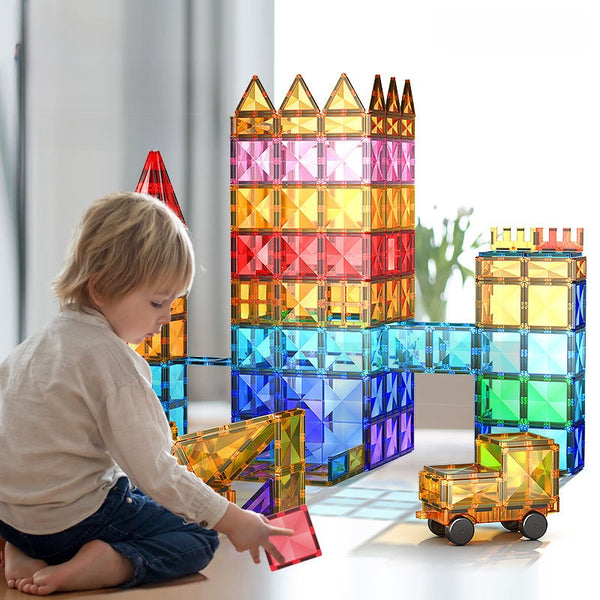
5. Magnetic Tiles (Connetix / Magna-Tiles) — Best for Geometric Intelligence

Intelligence developed: Geometric reasoning, 3D spatial visualisation, mathematical pattern recognition

Magnetic tiles develop geometric intelligence through the unique property of folding flat patterns into three-dimensional forms. Discovering that six squares fold into a cube, that four triangles make a tetrahedron, and that triangular members create rigid structures is genuine mathematical discovery — experiential learning of the same geometric facts that formal mathematics instruction teaches years later. Research on magnetic tile play has found measurable spatial reasoning improvements that transfer to geometric mathematics performance.

6. K’NEX — Best for Structural Engineering Intelligence

Intelligence developed: Structural mechanics, triangulation, systems thinking

K’NEX develops structural engineering intelligence through the discovery of triangulation: that diagonal bracing creates rigid structures from flexible components. This foundational engineering principle — discoverable through K’NEX play and subsequently explained in university engineering programmes — represents the kind of high-leverage structural knowledge that makes K’NEX a genuinely intelligent toy for children aged 7 and above.

7. Zometool — Best for Advanced Mathematical Intelligence

Intelligence developed: Three-dimensional geometry, symmetry, mathematical structure

Zometool is used in mathematics departments at universities globally to model three-dimensional geometric structures that are impossible to model any other way. The node-and-strut system encodes specific mathematical symmetries into the connection geometry, producing structures with remarkable properties. For children aged 8 and above with mathematical passion, Zometool provides the deepest mathematical intelligence development available through any physical building toy.

8. Meccano (Metal Construction) — Best for Mechanical Engineering Intelligence

Intelligence developed: Mechanical reasoning, gear systems, cause-and-effect mechanical chains

Meccano develops mechanical engineering intelligence through real metal components assembled with real tools into working mechanical models. Building a Meccano gear system that translates rotational speed to torque teaches the same mechanical advantage principles that physics and engineering education formalise. The mechanical intelligence developed through Meccano play is among the most directly applicable to professional engineering of any toy system available.

Why Building Toys Develop Intelligence Better than Academic Workbooks

The intelligence developed through building toy play is embodied, experiential, and deeply encoded — it is developed through hundreds of hours of genuine challenge, failure, and success in a physically real medium. This contrasts with workbook-based learning, which develops the ability to recognise and apply known procedures to familiar problem types but does not develop the original creative problem-solving, structural intuition, and spatial reasoning that building play uniquely provides. Research from MIT and multiple developmental universities identifies construction play as the single play format that most closely mirrors professional creative and engineering intelligence.

Find Building Toys That Develop Your Child’s Full Intelligence

Shop Building and Construction Toys

Also explore our STEM toys and puzzles and brain teasers.

Frequently Asked Questions: Building Toys for Intelligence, Creativity, and Problem-Solving

1. What are the best building toys for children’s intelligence, creativity, and problem-solving?

The best building toys for all three dimensions: KAPLA planks (balance engineering, creative elaboration, structural problem-solving), unit blocks (mathematical spatial intelligence), LEGO Classic open-ended (creative problem-solving), GraviTrax (physics engineering problem-solving), magnetic tiles (geometric intelligence), K’NEX (structural engineering intelligence), and Meccano (mechanical engineering intelligence). The richest development comes from having a primary system (one of the above used regularly in depth) supplemented by secondary systems that develop different cognitive dimensions.

2. Do building toys actually make children more intelligent?

Yes — specifically in spatial and mathematical intelligence. Multiple longitudinal research studies have found statistically significant advantages in spatial reasoning and mathematical performance in children with extensive construction toy experience compared to those without. The most rigorous research (controlling for parental education, IQ, and other variables) consistently finds independent effects of building toy play on spatial-mathematical intelligence that persist through primary and secondary school. The effects are largest for the 2–8 year window when spatial intelligence is developing most rapidly.

3. Why is spatial reasoning so important for intelligence?

Spatial reasoning is the ability to understand and mentally manipulate the positions, sizes, and relationships of three-dimensional objects. It is the cognitive foundation of mathematics (geometric thinking, graphing, algebraic manipulation), science (molecular structure, physical systems, biological anatomy), and engineering (structural design, mechanical systems). Research identifies spatial reasoning as among the strongest single predictors of achievement in STEM fields, outperforming general IQ in predicting mathematics and science performance. Crucially, spatial reasoning is highly trainable through building toy play in a way that general IQ is not.

4. Does LEGO improve intelligence?

Open-ended LEGO building (without instruction books) is consistently associated with improved spatial intelligence, mathematical reasoning, and creative problem-solving in children. The mechanism is through the spatial visualisation demands of translating imagined designs into physical LEGO structures and the engineering problem-solving of making designs structurally sound. Instruction-following LEGO develops spatial pattern reading and fine motor skill but contributes less to creative problem-solving intelligence. For maximum intelligence development: open-ended Classic LEGO building for most of the time, instruction-based sets for technique learning.

5. At what age do building toys develop intelligence most effectively?

Building toys develop intelligence most rapidly in the 2–8 year window, when spatial reasoning is developing most quickly and the neural plasticity for spatial-mathematical concept formation is at its peak. This does not mean older children and adults don’t benefit — spatial reasoning continues to develop through adolescence with appropriate challenge. But the developmental leverage of building toy play is highest in early childhood, making early and consistent access to quality construction toys a particularly high-value investment in long-term intellectual development.

6. What building toys are best for creativity specifically?

For creativity specifically: LEGO Classic (open-ended design), KAPLA planks (structural creative elaboration), loose parts (maximally open-ended creative use), magnetic tiles (geometric creative exploration), and unit blocks (mathematically structured creative construction). The key for creativity development is that the toy has no predetermined outcome: the child’s creative intelligence is the primary ingredient that determines what gets built. Any building toy used with instructions or templates develops technique but not creative intelligence.

7. What building toys are best for problem-solving specifically?

For problem-solving specifically: GraviTrax (physics engineering with defined goal and clear failure feedback), KAPLA planks (structural problem-solving through collapse-and-rebuild iteration), Rush Hour and logic puzzles (analytical problem decomposition), K’NEX (structural problem-solving through triangulation discovery), and robotics kits (computational problem-solving through programming and debugging). The most effective problem-solving toys are those where failure provides specific, informative feedback about what went wrong rather than just indicating that the attempt failed.

8. Can building play develop intelligence as effectively as academic tutoring?

For spatial and creative intelligence: yes, and likely more effectively. Academic tutoring develops academic content knowledge and procedural skill in specific subject areas. Building toy play develops the underlying spatial and creative cognitive structures that academic learning builds on. A child who enters mathematics education with strong spatial intelligence — developed through years of building play — will typically find mathematical concepts more accessible, require less tutoring, and develop mathematical intuitions that tutoring cannot efficiently install. Building play and academic support serve different developmental functions; neither substitutes for the other.

9. Do building toys help children with learning difficulties?

Building toys are frequently used therapeutically with children with learning difficulties because they develop cognitive capabilities through physical, multi-sensory engagement that bypasses the verbal-symbolic processing channels that many learning difficulties affect. Children with dyslexia, who struggle with verbal-symbolic processing, often show strong spatial intelligence that building toys can develop further. Children with ADHD often show hyperfocus in intrinsically interesting building challenges. Autistic children often have strong spatial-systematic intelligence that building toys specifically reward. Always consult relevant specialists for personalised recommendations.

10. How does building play develop executive function?

Building toy play develops executive function through: planning (deciding the construction sequence before placing pieces), inhibitory control (resisting placing pieces in non-optimal positions), working memory (holding the intended design in memory across a complex build), cognitive flexibility (updating plans when failures require redesign), and sustained attention (maintaining focus across a lengthy, complex construction task). All five components of executive function are simultaneously required in ambitious building play, making it one of the most comprehensive executive function training activities available for children.

11. Is there research specifically on building toys and intelligence?

Yes, substantial research. Key findings: Casey et al. (2008, MIT) found that block play experience in early childhood significantly predicted spatial reasoning and mathematics performance in school. Verdine et al. (2014, University of Delaware) found that block play with unit blocks predicted spatial mathematics scores at school entry. Wolfgang et al. (2001) found that block play complexity at preschool predicted mathematics achievement at both primary school and high school. Stannard et al. (2001) found dramatic play with blocks predicted scores on spatial reasoning assessments. The research base is unusually consistent in finding positive relationships between construction toy play and spatial-mathematical intelligence.

12. How much building toy play does a child need for intelligence benefits?

Research suggests that the benefits are cumulative: more high-quality building play produces stronger spatial and mathematical intelligence development. The studies showing the largest effects typically report children with high-complexity construction play experiences across multiple years of early childhood. Practically, this means: regular (daily or near-daily) access to quality building toys from age 2 through 8 provides the most significant intelligence development return. Occasional building sessions produce some benefit; sustained, regular engagement produces substantially more.

13. What is the difference between building toys and puzzle toys for intelligence?

Building toys develop constructive spatial intelligence: the ability to create three-dimensional structures from components. Puzzle toys develop analytical spatial intelligence: the ability to understand how existing structures decompose and recompose. Both develop spatial reasoning, but through different cognitive operations. Research suggests both are beneficial and complementary: construction toys for generative spatial intelligence, puzzles for analytical spatial intelligence. The most comprehensive spatial intelligence development comes from regular experience with both construction and puzzle formats across childhood.

14. Can screen-based building games like Minecraft develop intelligence?

Research on Minecraft and spatial intelligence is mixed but generally positive for spatial reasoning in the subset of players who engage in construction-focused (creative mode) rather than survival/combat gameplay. The spatial reasoning demands of designing and building three-dimensional structures in Minecraft are genuinely cognitively demanding. However, physical building toys have specific advantages: the tactile-motor engagement of physically placing objects develops embodied spatial reasoning that screen-only construction does not; and the real-world physical constraints (gravity, balance, connection strength) create more authentic engineering problem-solving than virtual physics allows.

15. What building toys work best alongside school mathematics?

Building toys that most directly complement school mathematics curriculum: unit blocks (develop the spatial-quantitative reasoning that arithmetic and geometry build on), Cuisenaire rods (develop number sense, fractions, and algebraic thinking), magnetic tiles (develop geometric shape and property understanding), KAPLA planks (develop proportional reasoning and ratio), and tangram and pentomino puzzles (develop the spatial rotation and decomposition skills geometry requires). The most effective mathematics-supporting building toy is the one that the child will engage with regularly and enthusiastically, regardless of which specific mathematics concepts it develops.

16. Where can I find the best building toys for intelligence and problem-solving?

Explore our complete range of building and construction toys at WonderKidsToy, selected for genuine spatial intelligence development, creative problem-solving challenge, and the multi-year engagement that compounds cognitive development across childhood.

Browse our full range of building and construction toys. For the smart play angle, see best building toys for smart play. For the problem-solving angle, see best problem-solving toys for kids.
Related Posts

Best Building Toys for Kids (2026): Creative Construction Play That Builds Smarter Minds
Building toys are some of the most powerful educational tools...
Best STEM Robotics Kits for Children in 2026
STEM robotics kits represent the convergence of the four STEM...
Best Learning Laptop Toys for Children in 2026
If you are searching for the best learning laptop toys for...
Best Toddler Laptop Toys in 2026
There is a moment every parent knows. You are typing...
Creativity is not a personality trait reserved for artists and...
Best Sensory Toys for Toddlers & Kids (2026): Calm, Fun & Educational Play
Sensory play is one of the most important parts of...
Back to blog

Top Picks (Quick Answer)

If you want the best options quickly, these are our top recommended toys based on learning value, fun, and long-term use.

BEST OVERALL

Creative Building Kits Educational Blocks Sets

A powerful all-in-one toy that helps kids build creativity, problem-solving skills, and focus through hands-on play.

Best for: creativity, building skills, and long-term engagement

Shop Now
BEST FOR YOUNGER KIDS

Jigsaw Puzzle Large 12 Piece Rainbow Blocks

Perfect for toddlers and preschoolers to build coordination, shape recognition, and early problem-solving skills.

Best for: ages 2–5, early learning, and hands-on play

Shop Now
Exclusive Bundle

FREE: Get $99 worth Creative Digital Vault

Order now and get instant access to 130+ Digital Learning Books. While your item ships, your child can start learning immediately!

✓ Link Sent Instantly to Your Email Post-Purchase