
Counting toys for toddlers are more than just fun playthings; they are essential tools for early childhood development. These toys introduce young children to the world of numbers while making learning an enjoyable experience. From building early math foundations to encouraging cognitive growth, the right mathematics and counting toys play a crucial role in a child's educational journey.
In this guide, we explore the importance of tactile numerical play, how to select safe and engaging tools, and creative ways to weave counting into your daily American lifestyle. These tools pair perfectly with our broader collection of educational toys to support every milestone.
Table of Contents
Numbers Can Feel Abstract and Intimidating
For a toddler, the concept of "three" or "five" is completely abstract. Simply reciting numbers in order is a feat of memory, but it isn't true mathematical understanding. Many parents try to teach math through flashcards or repetitive drills, but these methods often lack the sensory engagement that young brains require to build a real "number sense." Without a physical connection, math can quickly become a source of frustration rather than fascination.
Why Missing Hands-On Math Stalls Development
The early years are a peak "sensitive period" for order and logic. If children aren't given the chance to physically manipulate quantities—touching three blocks while saying "one, two, three"—they miss out on developing one-to-one correspondence. As we explored in our post on cognitive skill development, the absence of tactile math play can lead to struggles with school readiness later on. Passive learning, like watching a math video, doesn't challenge problem-solving or spatial reasoning the way physical counting toys do.
The Solution: Physical Manipulation for Mathematical Mastery
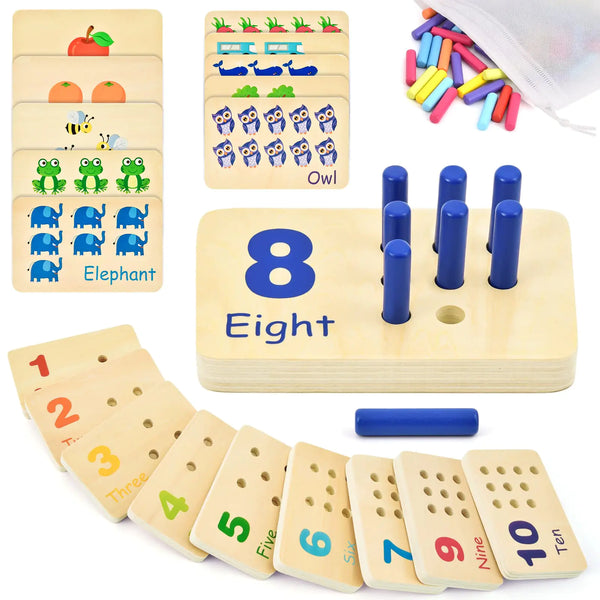
The best solution is to move math from the screen to the hand. High-quality counting toys turn numbers into something a child can grasp, stack, and sort. When a toddler moves a bead on an abacus or places a peg in a hole, they are receiving haptic feedback that reinforces the brain's understanding of quantity. This active participation is the hallmark of Montessori educational toys.
By utilizing these tools, you allow your child to lead their own discovery, building the independence and confidence needed for future academic success. These tools pair perfectly with problem-solving play sets to create a high-impact learning environment.
Ready to make numbers your child's favorite game?
Explore our expert-curated collection of counting and math toys designed for wobbly toddlers and curious preschoolers.
Shop Counting Toys NowTactile interaction with physical objects is the fastest way for toddlers to understand the logic of quantities.
Matching the Toy to the Developmental Stage
Every child is on a unique timeline. A 1-year-old needs large, graspable blocks, while a 4-year-old is ready for simple addition. Learn more about choosing for different ages in our expert guide to educational toys.
Counting Tool Quick Comparison
Stacking Rings
Best for: Developing hand-eye coordination
Benefits: Size differentiation, basic sequence
Age: 12 - 24 Months
Counting Pegs
Best for: Fine motor grip & precision
Benefits: One-to-one correspondence
Age: 2 - 4 Years
Number Puzzles
Best for: Numerical recognition
Benefits: Problem-solving, shape matching
Age: 3 - 5 Years
Expert Picks for 2026 Math Discovery
To truly maximize your child's mathematical journey, consider these high-impact examples that bridge the gap between play and school readiness.
The Structural Logic Masterpiece: Stacked High Block Toys
Math is often about understanding spatial relationships. Our stacked high block toys help children understand height, balance, and quantity simultaneously—a foundational skill for identifying how numbers grow.
Topical Authority: Supporting Growth
As we explored in our post on favorite Montessori math materials, the key is to provide a "Control of Error" so children can self-correct during their discovery.
Conclusion: Investing in a Lifetime of Logic
Counting toys are more than just playthings; they are the architectural tools for your child's logical mind. By choosing tactile engagement over passive drills, you are building a cognitive foundation that will serve them for a lifetime. As we discussed in our guide on the power of educational toys, every counted bead is a neural connection forged.
Ready to start your first count?
Browse our full range of mathematics and counting toys and prepare for your child's most exciting learning season yet.
Explore All Educational ToysFrequently Asked Questions About Counting Toys
1. What are the best counting toys for a 2-year-old?
Stacking rings, large number blocks, and counting bears are ideal for this age group.
2. Can counting toys help with speech delays?
Yes, the rhythmic nature of counting and the visual anchors provided by toys can support phonemic awareness.
3. How do I maintain wooden counting toys?
Wipe with a damp cloth and mild soap; never soak them, as it can cause the wood to warp.
4. Do kids need tech-based math games to succeed?
Not necessarily. Tactile physical toys offer sensory feedback that screens cannot match.
5. What is "one-to-one correspondence"?
It is the ability to match one spoken number to one physical object being counted.
6. Why choose wooden toys over plastic?
Wood is more durable, sustainable, and provides superior haptic feedback for developing hands.
7. Can counting toys support bilingual learning?
Absolutely. Counting the same objects in two languages helps build cross-linguistic foundations.
8. What is the benefit of an abacus?
It provides a linear visual representation of quantities and simple addition/subtraction.
9. Are there counting toys for infants?
Yes, soft blocks and high-contrast counting cards are great for 0-12 month infants.
10. How do I prevent math anxiety?
Keep it playful and child-led; avoid "drill and kill" methods and focus on discovery.
11. Do counting toys help with handwriting?
Pegging and stacking help build the fine motor grip needed for future pencil control.
12. Can a child learn to add solely from toys?
Toys are tools to build foundations; real-world context and parent guidance are essential partners.
13. What is "number sense"?
It is an intuitive understanding of quantities and how numbers relate to each other.
14. Are magnetic numbers safe for all ages?
No. Small magnets are a hazard. Only use them for children 3+ with adult supervision.
15. How long should a math play session last?
10-15 minutes is plenty for toddlers. Follow the child's interest and stop before frustration.
16. Why is color matching important in math?
It teaches categorization and attribute identification, both vital logic skills.
17. Do these toys help with school readiness?
Yes! Recognizing quantities before kindergarten gives children a massive confidence boost.
18. How do I clean plastic counting bears?
Wash with warm soapy water and air dry; they are usually dishwasher safe on the top rack.
19. Can toys help with dyscalculia?
Multisensory tools are often recommended by specialists for children with mathematical learning differences.
20. What is the benefit of number puzzles?
They teach spatial awareness and help children identify the written symbol for numbers.
21. Are flashcards better than counting toys?
For toddlers, physical toys are superior because they involve movement and sensory engagement.
22. Can I make my own counting toys?
Yes! Homemade bean bags or painted stones with numbers are fantastic budget-friendly options.
23. Why is "isolation of quality" important?
A toy should focus on one concept (like quantity) without being distracted by unnecessary lights or sounds.
24. Why choose Wonder Kids Toys for math gear?
We curate only high-quality, durable, and safety-vetted tools designed for genuine childhood joy.
25. Do counting toys help with vocabulary?
Yes, by associating number names with physical quantities, children broaden their logic vocabulary.
26. What is "subitizing"?
It is the ability to instantly recognize the number of objects in a small group without counting them one by one.
27. Do toys help with sorting by shape?
Many counting sets include different shapes, teaching categorization alongside numeracy.
28. Is supervision required during math play?
Yes, active adult interaction significantly boosts the educational value and ensures safety with small parts.
29. Can water toys be educational for math?
Yes, using numbered boats or measuring cups in the bath is a great way to keep math active.
30. Where can I find more math parenting tips?
Explore the Wonder Kids Toy blog for expert guides on early childhood development and learning through play.