 Skip to content


What the listing highlights
Nature puzzles · 17 themes · hands-on discovery turn nature pictures into questions, stories and puzzle play montessori biology puzzle boards for kids — plant and animal puzzle themes sup...

NATURE PUZZLES · 17 THEMES · HANDS-ON DISCOVERY Turn Nature Pictures Into Questions, Stories and Puzzle Play Montessori biology puzzle boards for kids — Plant and animal puzzle themes support supervised matching, science vocabulary and hands-on early biology exploration. This collection of biology-themed puzzle boards offers…
Choose any products across the store. Your savings increase automatically as you build your learning bundle.
Discount codes do not stack with automatic bundle savings. Checkout shows the offer applied to your order.
Order processing: Most in-stock orders are processed within 1–3 business days before shipment. The 3–7-business-day USA Fast Shipping estimate is separate from processing time.
USA Fast Shipping: Free for US orders. Shipping terms for Canada and the UK are shown at checkout.
Tracking: Tracking information is emailed when available. Please allow time after shipment confirmation for carrier tracking to begin updating.
Delivery estimates: Delivery times are estimates, not guaranteed arrival dates. Customs clearance, carrier delays, severe weather, public holidays, high seasonal volumes, remote-area delivery, local postal delays, transportation disruptions or warehouse availability can extend delivery.
If local or regional warehouse inventory is available, we may fulfill from that location. If local inventory is unavailable, delivery may take longer.
Customs & duties: Customers may be responsible for customs duties, import taxes, VAT/GST, brokerage fees or other government charges unless otherwise stated at checkout.
Multiple packages: Items in the same order may ship from different fulfillment locations and arrive separately. You are not charged extra standard shipping solely because an order is split.
Address changes: Please ensure your shipping address is complete and accurate. We will try to update errors reported quickly, but changes cannot be guaranteed once processing or shipment has begun.
Delayed or lost shipments: If tracking has not updated for an unusually long time or the order appears significantly delayed, contact our support team with your order number. If tracking shows delivered but the package cannot be located, first check your delivery area, mailbox or parcel locker, household members, neighbours where appropriate, building reception and the local carrier.
Refused or unclaimed shipments: If a shipment is refused, left unclaimed, or returned because customs requirements or delivery arrangements were not completed, applicable return or reshipping costs may be deducted where permitted.
Availability: Shipping availability may vary by product because of carrier restrictions, customs regulations, local laws, supplier limitations, product restrictions or warehouse availability.
Couldn't load pickup availability
SORT, TOUCH & EXPLORE
NATURE PUZZLES · 17 THEMES · HANDS-ON DISCOVERY
Montessori biology puzzle boards for kids — Plant and animal puzzle themes support supervised matching, science vocabulary and hands-on early biology exploration.
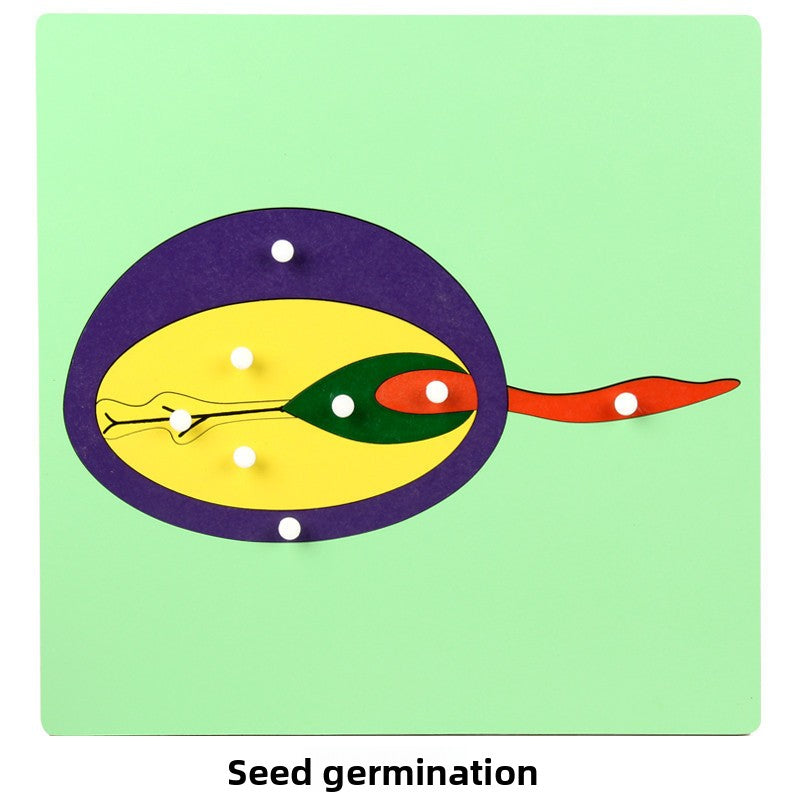
This collection of biology-themed puzzle boards offers 17 live options based on plants, insects, animals and natural processes. Current names include Big tree, Rooster, Butterfly, Flowers, Horse, Ant, Ladybug, Penguin, Frog, Dragonfly, Leaves, Turtle, Little Bird, Fish and Seed Germination, along with two unusually worded choices—Flies and “I know.”
Each variant is a separate theme, not a complete set of all 17 boards. Parents should select by the exact option name and matching image. These puzzles can support conversation about visible parts and nature topics, but they do not replace accurate science teaching. Materials, dimensions, labeled anatomy, piece counts and official Montessori status are not fully documented.
Choose one live nature subject from the variant menu.
Children can compare shapes, notice visible parts and rebuild the picture.
Adults can ask what the child sees without presenting unverified facts as science instruction.
No electronic or app-based function is documented.
Parents do not need to explain every biological detail before a child can enjoy the puzzle. Begin with what is visible: colors, shapes, wings, leaves, legs, petals or body sections. Let the child take the picture apart, examine the spaces and rebuild it at a comfortable pace.
When the child asks a question that the puzzle itself cannot answer, treat that as a reason to look for an age-appropriate book or trusted source later. This keeps the toy honest and useful: the board provides a physical subject for observation, while accurate explanations come from reliable educational materials.
Replay value can come from changing the prompts. Ask the child to find a curved edge, locate a matching color, describe one visible part or tell a short story about the subject. Siblings can take turns placing pieces or compare two separately purchased themes. Because each option is sold separately, confirm the chosen theme before expecting a pair or set.
The live option menu contains Flies, Big tree, Rooster, Butterfly, Flowers, Horse, Ant, Ladybug, Penguin, Frog, Dragonfly, Leaves, Turtle, Little Bird, Fish, “I know.” and Seed Germination. The “I know.” label is ambiguous and does not explain the pictured theme, so parents should rely on its matching product image or avoid that option until its identity is confirmed.
Exact content may vary substantially by theme. An insect puzzle may not have the same number or shape of pieces as a tree, bird or seed-germination puzzle. The listing confirms the option names but not scientific labeling, anatomical accuracy or included learning cards.
A completed nature puzzle can become the beginning of another activity. The child might compare the picture with a leaf found outdoors, imitate an animal movement or choose a library book about the same subject. Keep the puzzle’s role simple: it is a visual and physical prompt, not proof of a scientific fact. Rotating themes and following the child’s questions can extend interest more naturally than requiring repeated assembly on demand.
Children can look closely at outlines, colors and visible parts.
Each piece must be oriented and aligned with the board.
The subject can invite age-appropriate words when an adult knows them accurately.
The child can test, adjust and try another position without a single prescribed pace.
These are play opportunities, not guaranteed outcomes. Children develop at different rates, and the toy works best as one part of responsive play with appropriate adult support.
The live listing presents these as fully screen-free, manual puzzle boards. No battery, charging, audio, Wi-Fi or app feature is documented.
Materials and finishes are not fully confirmed. Keep the board dry, use a gentle wipe only and avoid strong cleaners or soaking unless supplied instructions allow it. Store each theme separately so pieces are not mixed between boards.
Use the exact package age guidance and supervise play until you know the pieces are suitable for the child. Inspect edges, small parts and any printed or layered surface before use. Stop using a board if pieces become damaged, sharp, loose or difficult to clean.
Verify that the delivered theme matches the selected name and image. Count the pieces using the package information, inspect the board and check that the completed picture can be assembled without forcing any part.
No. The 17 names are separate variants, and the selected option determines which puzzle is sent.
The menu includes insects, plants, animals, leaves, flowers and a Seed Germination option.
The name is ambiguous, so its subject should be confirmed from the matching variant image before ordering.
Scientific labels or anatomical teaching content are not confirmed in the listing.
No official certification is documented; the listing uses Montessori language for a hands-on puzzle format.
Yes. No screen or electronic function is documented.
No battery requirement is listed.
An exact age range is not confirmed, so follow the package label and evaluate the loose-piece sizes.
That is not confirmed and is unlikely to be identical across every subject; check the selected image and package.
No. They can prompt observation and conversation, but accurate explanations should come from reliable age-appropriate sources.
Yes, when two separate variants have been purchased and every piece is appropriate for both children.
Store each board and its pieces together to prevent themes from becoming mixed.
Confirm the selected subject, piece condition, board surface, package age guidance and any printed labels before play.
Open the option menu, match the theme name to its image and select the exact puzzle your child is most likely to revisit.
Review Options and Add to Cart
Add one more and save 10% on this companion pick.
Included with your order: a digital library of printable learning and creative activities for use at home.
Your access link is sent automatically by email after purchase.
Match the selected option to its product image, price and details before adding it to your cart.


These are editorial product insights based on the listing details—not customer reviews.
Nature puzzles · 17 themes · hands-on discovery turn nature pictures into questions, stories and puzzle play montessori biology puzzle boards for kids — plant and animal puzzle themes sup...
The listing connects this activity with science, engineering, robotics, or hands-on discovery.
The product information highlights tactile, Montessori-inspired, sensory, or fine-motor play.
The puzzle, building, block, or shape-based format may encourage planning, matching, and experimentation.
Use the description and images to decide whether Montessori Biology Puzzle Boards for Kids – Plant & Animal Science Learning Set suits your child's interests and current abilities.
Confirm the age guidance, dimensions, included pieces, materials, and supervision needs shown in the product details.
The exact product, model, colour, size, quantity and included accessories depend on the option selected above. Please review the selected variant and product description before ordering.
If your product arrives damaged, defective, incorrect, or with important parts missing, contact us within 30 days of delivery.
Please include your order number, a clear description of the issue, clear photos, a video when the issue cannot be shown clearly in photos, and packaging photos when relevant.
After review, an appropriate resolution may include a replacement, resend, partial refund, or full refund, depending on the circumstances.
For eligible products without a quality issue, change-of-mind return requests must be made within 7 days of receiving the product. Please contact us before returning any item. Returns sent without prior authorization may not be accepted.
For an eligible change-of-mind return, the customer is responsible for return shipping costs. The item must be unused and in its original condition, with original packaging, tags, accessories, manuals and included parts where applicable.
Returned products may be inspected. Items showing misuse, post-delivery damage, missing accessories or other conditions that make them unsuitable for return may not qualify for a refund.
Original shipping charges, customs duties, taxes, brokerage charges and other third-party fees are generally non-refundable unless required by applicable law or specifically approved as part of an order issue.
Order cancellations: Cancellation may be possible if an order has not entered processing or fulfillment. Once processed, customized, prepared for shipment or shipped, cancellation may no longer be possible. Customized, personalized, made-to-order, pre-order or specially prepared products may have additional restrictions.
Package not received: If a package appears significantly delayed, contact us with your order number and tracking information. If tracking shows delivered but you cannot locate it, first check your delivery location, household members, mailbox or parcel locker, neighbours where appropriate, building reception and the local carrier.
Refunds or replacements may not be available when delivery fails because of an incorrect or incomplete address, unknown recipient, refusal of delivery, failure to collect a package, failure to complete required customs clearance, or other circumstances outside our reasonable control.
Minor cosmetic damage to outer packaging may not qualify for a refund or replacement when the product itself is unaffected and fully usable.
Once a refund is approved, it is normally issued to the original payment method. Your bank, credit card company or payment provider may require additional time to display it.
Certain customized, personalized, made-to-order or other products that cannot reasonably be resold may not be eligible for change-of-mind returns.
Helpful ways to discover closely related toys, learning categories and parent guides.
🎯 Parent-Friendly Play Highlights
A closer look
Explore 6 highlighted product images. Tap an image for a larger view. The main gallery above contains all 22 images.
WONDERKIDSTOY · LEARNING THROUGH PLAY
As a parent, you want the excitement that comes with a new toy — but you also want the time your child spends with it to feel worthwhile. At WonderKidsToy, we focus on educational, STEM, Montessori-inspired and hands-on play that gives children something meaningful to do, discover and figure out for themselves.
We believe some of the best learning happens when children are busy building, testing, sorting, creating, imagining and asking “what happens if I try this?” Our goal is to make it easier for you to find engaging toys that encourage curiosity, creativity, problem-solving and independent exploration — without making playtime feel like homework.
Hands-on experiences that let children learn through doing, not just watching.
Explore STEM, science, puzzles, building, creative play and Montessori-inspired learning.
Toys that invite children to build, explore, imagine, experiment and solve.
Your purchase also includes our digital learning library with 130+ educational books and activities.
We’re here to help you find toys that feel worth bringing home — engaging enough for children to enjoy and purposeful enough for you to feel good about choosing them.


