Learning without feeling like homework
My daughter stays engaged much longer with educational toys when she can touch, build, sort and figure things out herself. It feels like play, but I can see the learning happening.
$0.00 CAD
Popular Pick • Limited Stock
🎯 Parent-Friendly Play Highlights
Couldn't load pickup availability
You save $136.0050% off
Secure checkoutProtected by Shopify
Free shippingWorldwide
Tracked deliveryTracking when available
Order supportDamage & order issues
Canada delivery: 9–12 business daysEstimated after dispatch · Free shipping included.
🔥
PURPOSEFUL PLAY FOR CURIOUS KIDS
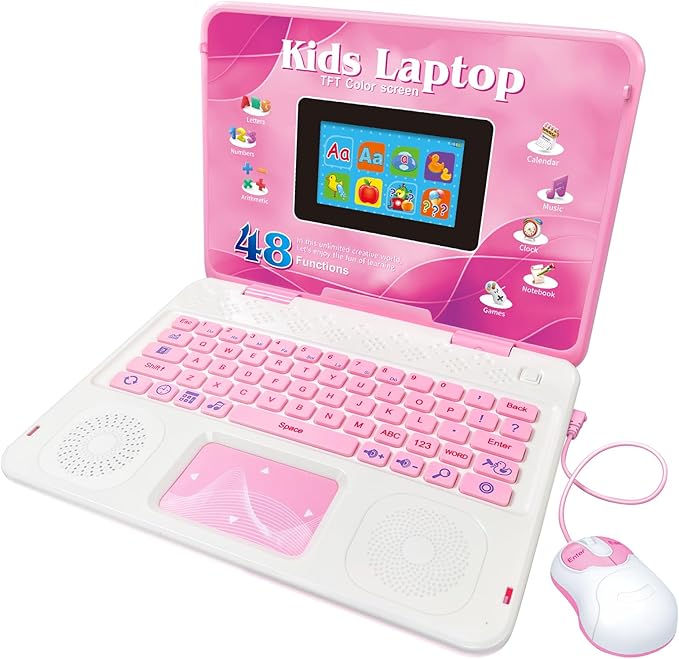
Finding a toy that keeps a child interested while also giving playtime a meaningful purpose can be difficult. Parents often see toys used briefly and then forgotten, especially when the activity is unclear or offers only one way to play. The Color-Screen Learning Laptop with Mouse – Interactive Skill-Building Play gives families a more purposeful option centered on participation, curiosity, and shared discovery. It is designed for parents looking for a color screen learning laptop toy with mouse that can support enjoyable play without turning every moment into a formal lesson.
Children learn naturally when they can explore, repeat, make choices, and receive calm encouragement. This product helps create that kind of environment. A parent can introduce one simple activity, allow independent exploration, and gradually add new prompts as confidence grows. The result is a toy that can fit into quiet afternoons, family play, learning breaks, rainy days, or gift occasions while keeping the child actively involved.
Parents value toys that are easy to understand, flexible enough for different play moods, and useful beyond a single exciting day. This activity toys can be introduced in short sessions, revisited over time, and combined with conversation or imaginative challenges. Instead of asking a child to sit through a long lesson, caregivers can follow the child’s attention and turn ordinary play into small opportunities for language, observation, turn-taking, and problem-solving. That practical flexibility makes it easier to use at home without adding pressure to a family routine.
The strongest learning value comes from what a child does during play. Depending on the chosen activity, children may practise attention, memory, matching, sequencing, descriptive language, coordination, planning, or creative thinking. Repetition can help a child become more familiar with an action, while small variations encourage flexible thinking. These are play opportunities rather than guaranteed developmental outcomes; every child responds differently. Parents can keep the experience positive by noticing effort, asking open questions, and avoiding pressure to perform a task perfectly.
Start by exploring the product with the child and naming the visible parts. Demonstrate one safe action, then invite the child to copy it or invent a new way to play. Ask simple questions: “What do you notice?”, “Which one will you choose?”, “What might happen next?”, or “Can you show me another way?” For pretend play, take turns creating roles or short stories. For matching, building, music, language, or movement activities, begin with an achievable challenge and increase complexity only when the child appears ready. Shared play works best when the adult follows curiosity instead of testing the child.
For accurate family decision-making, this product is classified as Screen-based learning toy. Parents should review the selected variant, product photographs, packaging, and included instructions before use because electronic features, charging method, batteries, sound, lighting, or display details can vary. Never describe an electronic product as screen-free unless the exact version is confirmed. If limiting media exposure is important to your family, use this classification and the variant details to decide whether the product fits your routine.
The live product listing currently shows these choices: Pink Color-Screen Laptop + Mouse. Select the required option carefully before adding it to the cart because colors, package configurations, accessories, power methods, and quantities may differ. The variant title is the best available reference at checkout. Exact materials, measurements, piece counts, batteries, cables, and package contents should be confirmed from the product images or packaging whenever they are not explicitly stated. This cautious check helps families avoid assuming that accessories shown for demonstration are included.
Use the child’s current abilities, not marketing language alone, to judge fit. A younger child may need close guidance and a very simple action, while an older child may enjoy rules, storytelling, or multi-step challenges. If age guidance is not clearly printed on the packaging, do not guess. Check the product images and instructions, consider the child’s coordination and tendency to mouth objects, and provide direct adult supervision. Stop use if the activity appears frustrating, unsafe, damaged, or unsuitable for the child.
Adult supervision is required. Inspect the product before every use and keep all packaging away from children. Confirm age grading, warnings, small-parts information, materials, power requirements, and assembly instructions on the received packaging. Keep loose, sharp, hot, damaged, or detached components out of reach. Electronic items should be kept dry unless the manufacturer specifically states otherwise, and battery compartments should be secured. Costumes, wearables, moving activities, and baby products require especially close supervision and a clear play space.
Follow the manufacturer’s care instructions because cleaning methods depend on the materials and electronics used. As a conservative approach, wipe suitable surfaces gently with a soft, slightly damp cloth and dry promptly; do not soak, machine-wash, or apply harsh chemicals unless the packaging clearly permits it. Remove batteries for long storage when instructed. Keep pieces together in a dry container, check connectors and seams regularly, and retire any component that becomes cracked, loose, frayed, or otherwise unsafe.
Choose the Color-Screen Learning Laptop with Mouse – Interactive Skill-Building Play when you want a parent-friendly activity that combines enjoyment with opportunities for participation and conversation. Review the selected option, confirm all packaging details on arrival, and introduce it with calm supervision. Add it to your family’s play collection today and use the ideas above to turn ordinary moments into engaging, child-led discovery.
It is best used for supervised, child-led play with simple parent prompts that encourage exploration, conversation, creativity, or skill practice.
This listing is classified as Screen-based learning toy. Review the exact selected variant and packaging before purchase if screen use is an important consideration.
Use the age grade printed on the product packaging. If it is not clearly shown, review the images and packaging for confirmation and consider the child’s abilities with adult supervision.
The listing shows: Pink Color-Screen Laptop + Mouse. Exact contents and accessories can vary by selection, so confirm the chosen variant, product images, and received packaging.
Power requirements are not assumed. Check the selected variant, product images, packaging, and instructions to confirm batteries, charging, cables, or adapters.
Play may offer opportunities for attention, communication, coordination, sequencing, imagination, or problem-solving depending on how the child uses it. Outcomes are not guaranteed.
Inspect it first, demonstrate one safe action, invite the child to explore, and use a few open-ended questions without turning play into a test.
Begin with direct adult supervision. Independence depends on the child’s age, abilities, the activity, and all safety information supplied with the product.
Rotate the toy, introduce a new story or challenge, pair it with drawing or conversation, and let the child choose different ways to play.
Follow the manufacturer’s instructions. Unless confirmed otherwise, use only conservative surface cleaning and keep electronic parts away from water.
It can be a thoughtful gift when the child’s interests, age guidance, available space, variant, and any setup or power needs have been checked.
Inspect for damage, confirm warnings and age grading, secure battery compartments where applicable, keep packaging away from children, and supervise use.
Verify the variant title, dimensions, materials, piece count, package contents, power method, age guidance, and warnings using the product images or packaging.

🎯 Parent-Friendly Play Highlights
A closer look
Explore 6 highlighted product images. Tap an image for a larger view. The main gallery above contains all 7 images.
Discover why parents choose hands-on educational toys to make learning, creativity and problem-solving part of everyday play.
My daughter stays engaged much longer with educational toys when she can touch, build, sort and figure things out herself. It feels like play, but I can see the learning happening.
I love toys that don’t need constant adult direction. My son can sit down, explore different possibilities and come back to the same toy in completely new ways.
The best educational toys are the ones kids actually ask to play with. We’ve seen more patience, better problem-solving and much more confidence when trying something new.
My child was hesitant with numbers, but using hands-on counting toys made a huge difference. It became much easier to understand quantities rather than just memorizing numbers.
We were looking for more hands-on activities at home. Educational toys give my kids something purposeful to do while still keeping them excited and curious.
Sorting, threading, stacking and building have really helped with hand control and focus. My daughter doesn’t even realize she’s practicing important skills.
A lot of toys are exciting for one day. The educational toys we like most have different challenges, so kids keep discovering new ways to use them.
We use educational toys in the afternoon when everyone needs a calmer activity. They’re especially helpful for keeping my child focused without needing a tablet.
I like seeing my son work through a challenge instead of immediately asking for help. These kinds of toys teach persistence in a very natural way.
My two kids can build and solve things together, which has been great for cooperation and communication. It’s much more interactive than many other toys we own.
We wanted activities that supported letters, numbers and fine motor skills before kindergarten. Educational toys made practice much more enjoyable.
The confidence boost is probably my favorite part. When my daughter completes a puzzle or figures something out on her own, you can see how proud she is.
My son is always asking how things work, so STEM and building toys are perfect for him. They give him a safe way to explore ideas and experiment.
We’ve noticed a real improvement in how long our child can stay with one activity. Open-ended educational toys seem to naturally encourage more focus.
We use educational toys alongside books and worksheets. They help turn abstract ideas into something kids can actually see and manipulate.
Creative learning toys give my child freedom to invent things instead of following one fixed outcome. That makes the play feel much more meaningful.
I’ve started choosing learning toys for birthday gifts because they feel more thoughtful. Kids enjoy them and parents appreciate the developmental value too.
My son resisted traditional letter practice, but once we brought in phonics and matching games, he became much more willing to participate.
My child learns best by doing, not just listening. Hands-on educational toys have been much more effective for keeping him engaged.
The toys we get the most value from are the ones with no single right way to play. Building sets, puzzles and pretend-play toys keep getting reused.
I’m a big believer that children learn best when they’re interested. The right educational toy gives them a reason to explore without pressure.
Good learning toys stretch my child just enough without frustrating him. When the difficulty is right, he keeps trying until he figures it out.
Educational toys give us something to talk about together. We ask questions, make predictions and talk through what we’re building or solving.
My kids remember concepts better when they’ve experienced them through play. It’s especially effective for math, science, building and early literacy.
My son usually moves from one activity to another very quickly, but building and logic toys keep him concentrating because there is always another solution to try.
These are exactly the kind of activities I want available when we’re stuck indoors. The kids stay busy while still building useful skills.
Hands-on manipulatives made numbers much easier for my daughter to understand. She now approaches basic math with much more confidence.
We wanted something exciting enough to compete with screens. Robotics, science and building toys have been some of the best options for our family.
I don’t expect every toy to be educational, but it’s wonderful when something is genuinely fun and also encourages thinking, creativity and curiosity.
That’s usually my test for a good learning activity. If she chooses it herself the next day, I know we’ve found something worthwhile.
Science toys have created so many conversations in our house. My son wants to know why things happen instead of just watching them happen.
The biggest difference for us is repeat play. My children keep returning to toys that allow them to create different things each time.
We rotate toys during the week and the educational activities are usually among the first ones my daughter chooses when they come back out.
I really like watching my child move from needing help to completing something independently. Those little successes build so much confidence.
We prefer toys that encourage kids to actually do something: experiment, build, imagine, solve or create. Those are the ones that last in our house.
What I like most is that there doesn’t need to be a formal lesson. Kids naturally practice reasoning, creativity and coordination while they’re enjoying themselves.