Hands-On Control
Gives kids a hands-on way to interact with movement and control rather than only watching a screen.
$0.00 CAD


Popular Pick • Limited Stock
🎯 Parent-Friendly Play Highlights
Couldn't load pickup availability
You save $562.0050% off
Secure checkoutProtected by Shopify
Free shippingWorldwide
Tracked deliveryTracking when available
Order supportDamage & order issues
Canada delivery: 9–12 business daysEstimated after dispatch · Free shipping included.
🔥
Looking for a toy that can hold attention while giving children something active to do? Gray Wooden Play Kitchen for Kids brings play, exploration and parent-guided learning together in one adaptable activity.
Gray Wooden Play Kitchen for Kids gives families a practical way to turn ordinary playtime into a more focused hands-on pretend-play and learning toy. Instead of relying on passive entertainment, children can explore through hands-on choices, repetition and discovery. Parents can introduce the toy gradually, demonstrate the first step, and then allow the child to take increasing ownership. This page uses the product title, current variants and available store information only. Exact age guidance, materials, dimensions, accessories, batteries, charging requirements and package contents should always be checked on the selected option, product images or delivered packaging before use.
A useful toy should fit real family routines, not only look appealing in a photo. Gray Wooden Play Kitchen for Kids can be brought into quiet-time play, a supervised learning break, a weekend project or a shared parent-child activity. Its strongest value comes from the way caregivers can adjust the challenge: simplify the task for a first attempt, ask open-ended questions as confidence grows, or invite the child to explain the steps. The activity may support language, turn-taking, coordination, imagination and practical problem solving. These are play opportunities rather than guaranteed developmental outcomes, and each child can engage at a different pace.
Begin by letting the child look at the pieces, controls, surfaces or illustrated choices included with the selected version. Ask what they notice before explaining the goal. Next, model one short action and invite the child to repeat or adapt it. During play, use simple prompts such as “What could happen next?”, “Which piece might fit?”, or “How could we try another way?” Keep the session relaxed and stop before frustration becomes overwhelming. Repeating the activity on another day can help children remember the sequence and discover a new strategy without turning play into a test.
Hands-on play becomes educational when children make decisions and notice the result. With this hands-on pretend-play and learning toy, they may compare options, follow a sequence, correct a mistake and complete a small goal. Parents can support vocabulary by naming actions, colors, positions, shapes, themes or tools that are genuinely visible in the selected set. Encourage the child to describe what they are doing rather than supplying every answer. This creates space for reasoning and communication. Avoid promising that one product will teach a complete subject or produce a specific milestone; the value comes from regular, age-appropriate interaction and supportive guidance.
Fully screen-free based on the current listing unless the selected option includes a powered feature. Parents should not describe a powered toy as screen-free simply because it does not use a phone. Check whether the chosen option includes lights, sounds, a display, remote control, Wi-Fi, charging cable or batteries. If power information is unclear, review the product images or packaging for confirmation before giving the toy to a child. Keep battery compartments secured, use only the stated power source, and follow the manufacturer’s charging and storage instructions. For non-powered options, the activity can be included in a family’s hands-on or low-tech play routine.
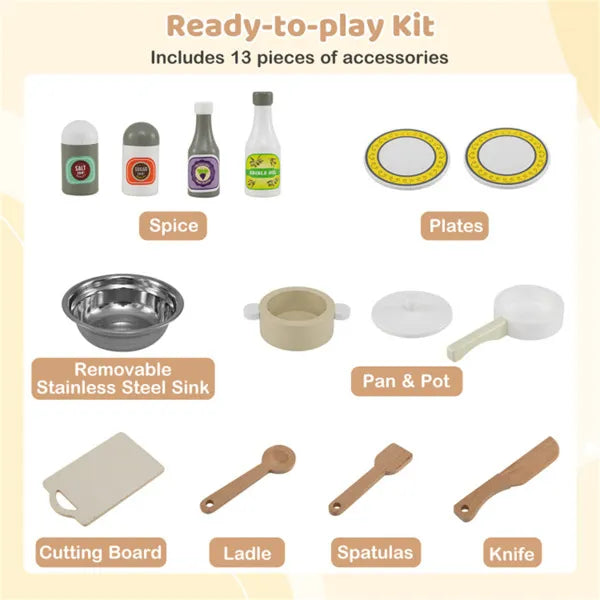
Current store options include: Gray Play Kitchen. Variant names may refer to a design, theme, piece count, packaging style, color, size or powered configuration. Read the complete selected option at checkout because images may show more than one version together. Do not assume accessories pictured beside the main item are included unless the option or package list confirms them. When a variant title uses supplier wording, compare it carefully with the product images. Parents should choose according to the child’s interests, current abilities, available play space and the supervision they can provide.
Try a short “notice, choose, explain” routine. First ask the child to notice three details. Next let them choose a starting piece, control, picture or task. Finally, invite them to explain what happened. A second idea is cooperative turn-taking: the adult completes one step and the child chooses the next. For creative products, add a storytelling prompt connected to the finished result. For construction or puzzle products, reset the finished project for another attempt. Keep added materials age-appropriate and never substitute household objects that create new hazards.
Before ordering Gray Wooden Play Kitchen for Kids, review the selected variant, price, estimated delivery details and available product photographs. Confirm that the activity fits the intended play area and that storage is practical after use. Check whether adult assembly, batteries, charging, water, protective surfaces or cleanup supplies are required. Families buying a gift should avoid guessing the age range; use the manufacturer’s label and consider whether the recipient already owns similar items. If precise materials, measurements, piece counts or included accessories are important, please review the product images or packaging for confirmation before relying on the listing title alone.
Adult supervision is recommended. Follow the age label, warnings and assembly directions supplied with the delivered product. Keep small parts, magnets, batteries, cords, sharp tools, liquids and breakable components away from children whenever they are not explicitly age-appropriate and secured. Inspect the toy before each session for cracks, loose parts, damaged wires, exposed fasteners or missing pieces. Powered products should be used only with the stated controls and power source. Ride-on, climbing or movement products require a clear area and any protective equipment identified by the manufacturer. Stop use immediately if the product is damaged or behaves unexpectedly.
Use the care method stated for the verified material. As a cautious default, wipe suitable surfaces with a soft, lightly damp cloth, avoid soaking, and dry everything before storage; electronic parts should never be exposed to moisture unless the instructions specifically allow it. Count loose pieces after play and store them in a labeled container away from younger siblings or pets. Gray Wooden Play Kitchen for Kids may suit birthdays, holidays, homeschool activity baskets or family project time when the recipient’s age and interests match the verified guidance. A thoughtful gift includes time to help with setup and the first supervised play session.
It is a hands-on pretend-play and learning toy designed for supervised, hands-on engagement.
Fully screen-free based on the current listing unless the selected option includes a powered feature.
Play may support language, turn-taking, coordination, imagination and practical problem solving, depending on how the child uses it.
Compare the complete variant name, images and package information before ordering.
Not necessarily. Please review the selected option, product images or packaging for confirmation.
Use the verified age label and warnings on the delivered packaging; do not rely on appearance alone.
Power requirements vary by product and option. Confirm them for the selected variant.
Adult supervision is recommended, especially during setup, first use and play involving small or powered parts.
Model one simple step, then let the child explore and make choices at a comfortable pace.
Follow the material-specific instructions and avoid excess moisture or harsh cleaners.
Count loose parts and store the complete set in a dry, secure container.
It can be when the verified age guidance, interests, space and supervision needs suit the recipient.
Confirm the selected variant, contents, materials, dimensions, warnings, power needs and condition before use.
Review the selected variant, images, packaging details and safety guidance, then add a purposeful hands-on activity to your family’s play routine.


A quick product-specific snapshot of Gray Wooden Play Kitchen for Kids.
Gives kids a hands-on way to interact with movement and control rather than only watching a screen.
Steering, positioning and responsive control can support hand-eye coordination through play.
Repeated use gives children a fun way to practise timing, direction and control.
Movement-based play can make this a toy children are excited to come back to.
Operating an interactive toy can encourage attention and concentration during play.
A strong option for birthdays and special occasions when you want a toy with instant excitement.
Best suited to supervised practice in a clear, permitted outdoor area with suitable open space.
Learning how to control the toy can help children build confidence through practice.
Combines play with simple technology in a way that feels exciting and approachable.
Short play sessions are easy to return to, which can help keep the toy in regular rotation.
Can create opportunities for parents and children to play, guide and explore together.
The movement and interactive control can make each play session feel different and memorable.
🎯 Parent-Friendly Play Highlights
A closer look
Explore 6 highlighted product images. Tap an image for a larger view.
Discover why parents choose hands-on educational toys to make learning, creativity and problem-solving part of everyday play.
My daughter stays engaged much longer with educational toys when she can touch, build, sort and figure things out herself. It feels like play, but I can see the learning happening.
I love toys that don’t need constant adult direction. My son can sit down, explore different possibilities and come back to the same toy in completely new ways.
The best educational toys are the ones kids actually ask to play with. We’ve seen more patience, better problem-solving and much more confidence when trying something new.
My child was hesitant with numbers, but using hands-on counting toys made a huge difference. It became much easier to understand quantities rather than just memorizing numbers.
We were looking for more hands-on activities at home. Educational toys give my kids something purposeful to do while still keeping them excited and curious.
Sorting, threading, stacking and building have really helped with hand control and focus. My daughter doesn’t even realize she’s practicing important skills.
A lot of toys are exciting for one day. The educational toys we like most have different challenges, so kids keep discovering new ways to use them.
We use educational toys in the afternoon when everyone needs a calmer activity. They’re especially helpful for keeping my child focused without needing a tablet.
I like seeing my son work through a challenge instead of immediately asking for help. These kinds of toys teach persistence in a very natural way.
My two kids can build and solve things together, which has been great for cooperation and communication. It’s much more interactive than many other toys we own.
We wanted activities that supported letters, numbers and fine motor skills before kindergarten. Educational toys made practice much more enjoyable.
The confidence boost is probably my favorite part. When my daughter completes a puzzle or figures something out on her own, you can see how proud she is.
My son is always asking how things work, so STEM and building toys are perfect for him. They give him a safe way to explore ideas and experiment.
We’ve noticed a real improvement in how long our child can stay with one activity. Open-ended educational toys seem to naturally encourage more focus.
We use educational toys alongside books and worksheets. They help turn abstract ideas into something kids can actually see and manipulate.
Creative learning toys give my child freedom to invent things instead of following one fixed outcome. That makes the play feel much more meaningful.
I’ve started choosing learning toys for birthday gifts because they feel more thoughtful. Kids enjoy them and parents appreciate the developmental value too.
My son resisted traditional letter practice, but once we brought in phonics and matching games, he became much more willing to participate.
My child learns best by doing, not just listening. Hands-on educational toys have been much more effective for keeping him engaged.
The toys we get the most value from are the ones with no single right way to play. Building sets, puzzles and pretend-play toys keep getting reused.
I’m a big believer that children learn best when they’re interested. The right educational toy gives them a reason to explore without pressure.
Good learning toys stretch my child just enough without frustrating him. When the difficulty is right, he keeps trying until he figures it out.
Educational toys give us something to talk about together. We ask questions, make predictions and talk through what we’re building or solving.
My kids remember concepts better when they’ve experienced them through play. It’s especially effective for math, science, building and early literacy.
My son usually moves from one activity to another very quickly, but building and logic toys keep him concentrating because there is always another solution to try.
These are exactly the kind of activities I want available when we’re stuck indoors. The kids stay busy while still building useful skills.
Hands-on manipulatives made numbers much easier for my daughter to understand. She now approaches basic math with much more confidence.
We wanted something exciting enough to compete with screens. Robotics, science and building toys have been some of the best options for our family.
I don’t expect every toy to be educational, but it’s wonderful when something is genuinely fun and also encourages thinking, creativity and curiosity.
That’s usually my test for a good learning activity. If she chooses it herself the next day, I know we’ve found something worthwhile.
Science toys have created so many conversations in our house. My son wants to know why things happen instead of just watching them happen.
The biggest difference for us is repeat play. My children keep returning to toys that allow them to create different things each time.
We rotate toys during the week and the educational activities are usually among the first ones my daughter chooses when they come back out.
I really like watching my child move from needing help to completing something independently. Those little successes build so much confidence.
We prefer toys that encourage kids to actually do something: experiment, build, imagine, solve or create. Those are the ones that last in our house.
What I like most is that there doesn’t need to be a formal lesson. Kids naturally practice reasoning, creativity and coordination while they’re enjoying themselves.