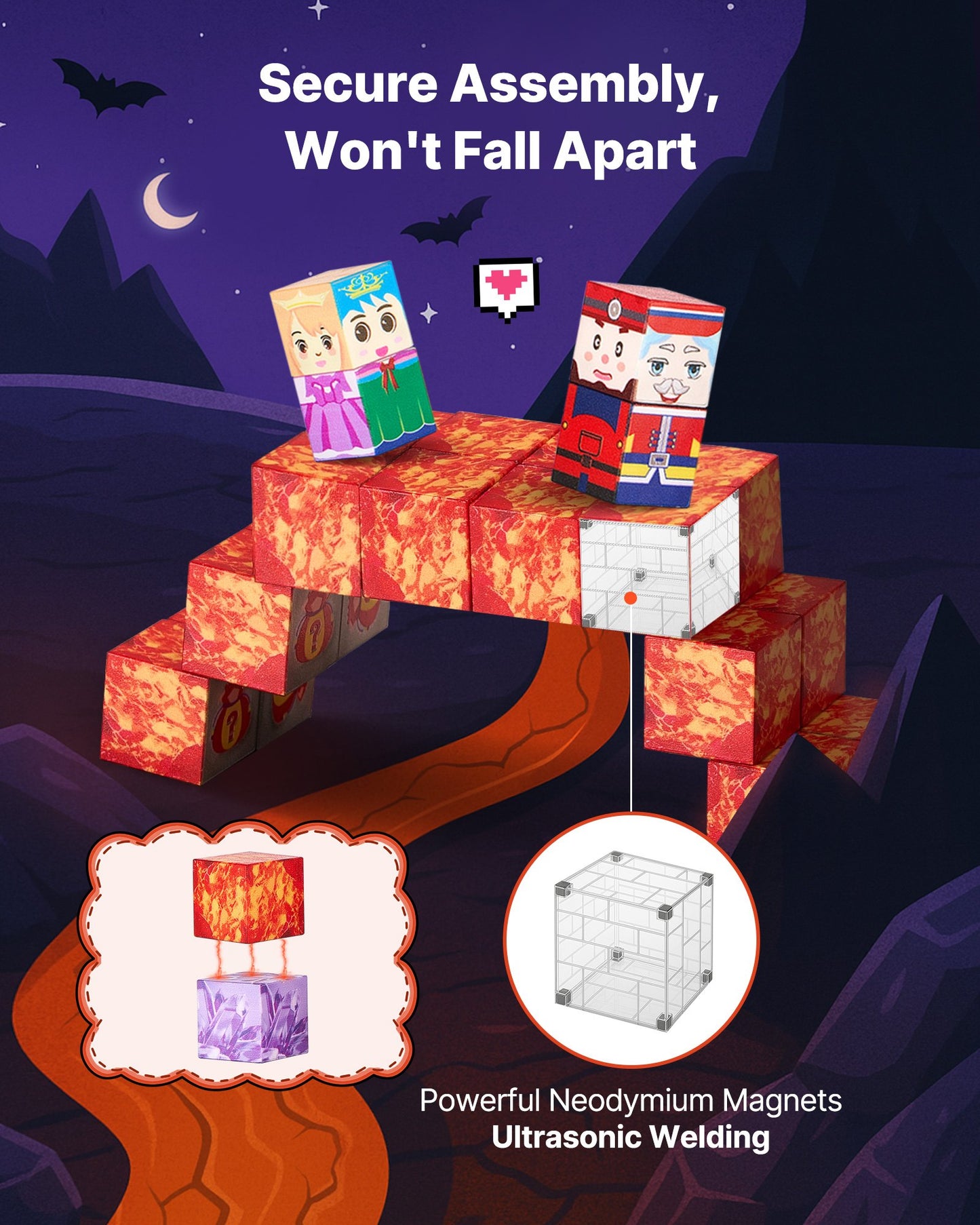

SCIENCE KITS VS MAGNETIC TILES · 2026
Science kits and magnetic tiles can both support hands-on play, but the buying experience is different. Science activities are usually guided and may involve tools or consumables. Magnetic tiles and blocks are designed for repeated building. Compare setup, cleanup, supervision, repeat use and storage before choosing.
Shop Science Kits
Table of Contents
Which Type Should You Buy?
Science kit
Choose for a guided sequence, experiment theme or specific observation activity.
Microscope
Choose for reusable close-up viewing of safe everyday materials.
Magnetic tiles or blocks
Choose for repeatable open-ended construction with many possible builds.
Robot or engineering kit
Choose for a guided assembly project with a finished mechanical result.
What to Compare Before Buying
Guided or open-ended
Science kits typically follow instructions; magnetic construction allows many outcomes.
Consumables and repeat use
Check whether experiments use supplies once, while tiles, microscopes and many engineering sets can be reused.
Supervision and cleanup
Review tools, liquids, small components, magnets and cleanup instructions for the exact product.
Storage footprint
Compare the number of pieces, trays, containers and whether a finished project will be displayed.
Age and Use-Case Guidance
Preschool construction
Larger, simpler magnetic building formats may be easier to manage than multi-step experiment kits, subject to exact product guidance.
School-age projects
Microscopes, robots and guided science kits suit users interested in completing a specific activity.
Repeat family play
Magnetic building sets are easy to rebuild, while a microscope can be reused with different safe materials.
Gift choice
Choose a science kit for a defined project and magnetic construction for longer-term building variety.
Current Science and Magnetic Options


Science Kit vs Magnetic Building Set
Science activity
Format: guided steps or close observation.
Plan for: instructions, supervision, cleanup and possible consumables.
Magnetic building
Format: repeated open-ended construction.
Plan for: piece count, magnet condition, storage and build surface.
Frequently Asked Questions
1. Are science kits better than magnetic tiles?
Neither is universally better. Choose guided science activity or repeatable construction based on the desired use.
2. What is easier to reuse?
Magnetic building sets are designed for rebuilding; microscopes are also reusable, while some experiments use consumables.
3. Do science kits require adult supervision?
Many do. Follow the exact instructions and supervision guidance for the selected kit.
4. Are magnetic blocks the same as magnetic tiles?
Both use magnetic construction, but shapes, connectors and building style can differ.
5. What should I check before buying magnetic toys?
Review age guidance, piece construction, magnet enclosure, piece count and storage.
6. What should I check in a science kit?
Check contents, required household items, consumables, tools, cleanup and supervision.
7. Is a microscope a science kit?
It is a science tool rather than a packaged experiment kit, but it supports reusable observation activities.
8. Are robot kits science toys?
They are usually grouped with STEM or engineering toys and may include science-related ideas through assembly.
9. Which is better for a gift?
Choose a defined kit for a project-focused recipient or magnetic construction for repeated building.
10. Where can I shop both categories?
WonderKidsToy has live collections for science kits and magnetic building toys.
Choose Guided Discovery or Open-Ended Building
Start with the preferred activity, then compare repeat use, pieces, supervision, cleanup and storage.
Buy Science KitsContinue Shopping by Learning Goal
Start with Science Kits Experiments, then explore Educational Toys and STEM Toys.
Secure checkout • Free worldwide shipping • Review current product details before purchase
A practical framework for comparing science kits with magnetic building toys
This expanded guide keeps informational intent in the article and directs product comparison to verified collections. Start with the learner, define one useful purpose and rely on the current product page for specific facts.
Choose by activity type
Focus on deciding between observation, experimentation and construction. Observe how the learner begins, where brief help is useful and whether the activity invites another calm attempt. The aim is an understandable experience with room to practise, not a performance test. Avoid buying by the STEM label without a clear use. Adjust one element at a time so the learner can notice what changed and retain ownership.
Before the next session, decide what success realistically means: beginning independently, completing one step, asking for help, checking an attempt or explaining an observation. These visible actions provide better information than broad product promises. Stop when frustration or unsafe use replaces purposeful engagement, reset the activity and try a simpler version later.
Compare setup time
Focus on checking preparation, cleanup and adult assistance. Observe how the learner begins, where brief help is useful and whether the activity invites another calm attempt. The aim is an understandable experience with room to practise, not a performance test. Avoid assuming every kit supports independent use. Adjust one element at a time so the learner can notice what changed and retain ownership.
Before the next session, decide what success realistically means: beginning independently, completing one step, asking for help, checking an attempt or explaining an observation. These visible actions provide better information than broad product promises. Stop when frustration or unsafe use replaces purposeful engagement, reset the activity and try a simpler version later.
Look for repeatability
Focus on planning new samples, structures or questions. Observe how the learner begins, where brief help is useful and whether the activity invites another calm attempt. The aim is an understandable experience with room to practise, not a performance test. Avoid treating a single finished result as the only value. Adjust one element at a time so the learner can notice what changed and retain ownership.
Before the next session, decide what success realistically means: beginning independently, completing one step, asking for help, checking an attempt or explaining an observation. These visible actions provide better information than broad product promises. Stop when frustration or unsafe use replaces purposeful engagement, reset the activity and try a simpler version later.
Use prediction and evidence
Focus on asking what may happen and what was observed. Observe how the learner begins, where brief help is useful and whether the activity invites another calm attempt. The aim is an understandable experience with room to practise, not a performance test. Avoid telling the child the result before testing. Adjust one element at a time so the learner can notice what changed and retain ownership.
Before the next session, decide what success realistically means: beginning independently, completing one step, asking for help, checking an attempt or explaining an observation. These visible actions provide better information than broad product promises. Stop when frustration or unsafe use replaces purposeful engagement, reset the activity and try a simpler version later.
A verified active product to compare
Confirm exact variants, contents, dimensions, age guidance and warnings on the current listing.

Check magnetic safety
Focus on following warnings and inspecting enclosed components. Observe how the learner begins, where brief help is useful and whether the activity invites another calm attempt. The aim is an understandable experience with room to practise, not a performance test. Avoid using damaged magnetic pieces or loose magnets. Adjust one element at a time so the learner can notice what changed and retain ownership.
Before the next session, decide what success realistically means: beginning independently, completing one step, asking for help, checking an attempt or explaining an observation. These visible actions provide better information than broad product promises. Stop when frustration or unsafe use replaces purposeful engagement, reset the activity and try a simpler version later.
Review microscope limits
Focus on checking magnification, lighting and sample preparation. Observe how the learner begins, where brief help is useful and whether the activity invites another calm attempt. The aim is an understandable experience with room to practise, not a performance test. Avoid promising laboratory-quality results from a toy listing. Adjust one element at a time so the learner can notice what changed and retain ownership.
Before the next session, decide what success realistically means: beginning independently, completing one step, asking for help, checking an attempt or explaining an observation. These visible actions provide better information than broad product promises. Stop when frustration or unsafe use replaces purposeful engagement, reset the activity and try a simpler version later.
Match the learner
Focus on considering patience, hand control and reading demands. Observe how the learner begins, where brief help is useful and whether the activity invites another calm attempt. The aim is an understandable experience with room to practise, not a performance test. Avoid choosing complexity based only on calendar age. Adjust one element at a time so the learner can notice what changed and retain ownership.
Before the next session, decide what success realistically means: beginning independently, completing one step, asking for help, checking an attempt or explaining an observation. These visible actions provide better information than broad product promises. Stop when frustration or unsafe use replaces purposeful engagement, reset the activity and try a simpler version later.
Plan a manageable rotation
Keep a small number of complete activities available and store the rest. Rotate when interest fades or clutter interferes, but retain favourites when familiarity supports deeper planning. Change one prompt, rule, sample or partner before buying something new.
Check setup and storage
Review exact contents, dimensions, assembly, power and cleanup needs. Product photos may not show scale accurately. Decide where every component will be stored and whether partially finished work needs protection, especially when younger siblings share the space.
Age guidance and safety
Follow the current listing and packaging for age guidance, warnings and included parts. Consider mouthing, throwing, mobility, vision, hearing and small-component use. Inspect for damage, use a stable surface and supervise for the individual child. Do not infer materials, certification or safety testing from images.
Compare the correct collections
Compare science kits, magnetic building toys, STEM toys, educational toys. Collection pages own transactional intent; this article explains selection and use. Choose by purpose, challenge, setup and safe fit rather than collecting many similar products.
Final buying checklist
- Confirm age guidance, warnings, dimensions, variants and contents.
- Match required movements, attention and reading demands.
- Identify one purpose and two realistic uses.
- Plan setup, cleanup, storage and supervision.
- Choose an activity that can be simplified or extended.
- Avoid unsupported developmental, material or safety promises.
Common questions from parents and educators
How do I know the level fits?
The learner should understand how to begin and make progress with limited help. Simplify when frustration dominates.
Should I demonstrate first?
Show the essential action briefly, then allow time for exploration.
What if the child uses it differently?
Observe first when the different use remains safe and relevant.
Can the toy guarantee progress?
No. It offers practice opportunities, while outcomes depend on many factors.
How should products be compared?
Check contents, dimensions, warnings, actions, setup and fit.
How often should activities rotate?
Rotate when interest fades; keep familiar materials when use deepens.
Are more features better?
Not always. Choose features that serve the intended activity.
When is professional advice helpful?
Seek guidance when individualized needs affect access or safety.
What should be verified?
Review current variants, included pieces, power needs and warnings.
What happens before first use?
Read instructions, inspect components and introduce one clear purpose.
Final takeaway
The strongest choice fits the learner, the real environment and a clear purpose. Begin simply, observe what works and adapt the next session using evidence rather than product promises.
Review the featured product before choosing
Confirm exact variants, contents, dimensions, age guidance and warnings on the current listing.