Quick Answer:
Montessori toys are educational materials specifically designed to support a child's natural development through hands-on, self-directed learning. Based on Dr. Maria Montessori's educational philosophy, these toys help children ages 2-12 develop fine motor skills, problem-solving abilities, independence, and concentration—all while having fun and exploring at their own pace.
Table of Contents
- What Are Montessori Toys? (Detailed Definition)
- The History Behind Montessori Toys
- 7 Key Characteristics of Montessori Toys
- The Real Benefits: What Science Says
- 5 Types of Montessori Toys Every Parent Should Know
- How Montessori Toys Compare to Traditional Toys
- How to Choose the Right Montessori Toy for Your Child
- Where to Buy Quality Montessori Toys
- Frequently Asked Questions
- Ready to Start Your Montessori Journey?
What Are Montessori Toys? (Detailed Definition)
Montessori toys are carefully designed learning materials that embody the principles of the Montessori method—an educational approach developed by Italian physician and educator Dr. Maria Montessori over 100 years ago. Unlike typical toys that simply entertain, Montessori materials serve a specific developmental purpose.
These toys encourage "learning by doing." Instead of a parent or teacher telling a child how something works, a Montessori toy guides the child to discover the answer themselves. A child might manipulate a wooden cylinder puzzle not because an adult told them to, but because the toy itself invites exploration and self-correction.
The philosophy is simple: children learn best when they're actively engaged in their learning process. Montessori toys remove unnecessary distractions—bright colors, loud sounds, flashy animations—and focus on the core learning experience. This helps children develop deep concentration, patience, and genuine understanding of concepts.
Core Definition:
Montessori toys are materials that combine simplicity, beauty, and purpose to guide children through sensory exploration, practical life skills, and academic concepts. They respect each child's pace of development and encourage independence, critical thinking, and love of learning.
The History Behind Montessori Toys
Dr. Maria Montessori (1870-1952) was a revolutionary thinker in education. As both a physician and educator, she observed thousands of children and noticed something powerful: when given the right environment and tools, children naturally want to learn.
In 1906, Dr. Montessori opened her first "Casa dei Bambini" (House of Children) in Rome. She didn't have a large budget for fancy toys. Instead, she worked with local craftspeople to create simple, purposeful materials. These early Montessori materials were designed with specific learning goals in mind—not to entertain, but to educate.
What surprised everyone was how engaged children became. They would work with materials for hours, repeating activities until they mastered them. Children who were previously considered "difficult" became focused, confident learners. Word spread quickly, and the Montessori method expanded globally.
Today, over 20,000 Montessori schools operate worldwide, and Montessori toys are used in homes across the globe. The fundamental principle remains the same: quality materials that invite exploration and support natural development.
7 Key Characteristics of Montessori Toys
Not every educational toy is a Montessori toy. Authentic Montessori materials share specific qualities:
1. Purpose-Driven Design
Each Montessori toy targets a specific skill or concept. A pink tower isn't just "stacking blocks"—it develops spatial awareness, fine motor control, and the ability to observe gradations in size. A child using it isn't randomly playing; they're systematically building understanding.
2. Self-Correcting
Montessori toys provide immediate, non-punitive feedback. If a puzzle piece doesn't fit, the child realizes it immediately without adult intervention. This builds problem-solving skills and allows children to learn from mistakes independently—a crucial life skill.
3. Beautiful and Natural
Montessori materials use high-quality natural materials: wood, metal, fabric, and ceramics. They're aesthetically pleasing because Dr. Montessori believed that beauty invites engagement. A child is more likely to choose a lovely wooden toy over a plastic one filled with loud sounds.
4. Sensory Development
Montessori toys engage multiple senses. A child might feel smooth wood, hear subtle sounds, see color variations, and experience weight and balance. This multi-sensory approach deepens learning and memory formation.
5. Promotes Independence
The goal isn't for a parent to "teach" using the toy—it's for the child to teach themselves. Materials are designed so children can use them with minimal adult guidance. This builds confidence and self-reliance.
6. Encourages Concentration
Montessori toys are calm and focused, without flashing lights or overstimulating features. This allows children to develop the ability to concentrate deeply, which improves academic performance and emotional regulation.
7. Supports Natural Development
Montessori materials are age-appropriate and follow the natural progression of child development. A toy for a 2-year-old develops different skills than one for a 5-year-old, but both support where the child is developmentally.
The Real Benefits: What Science Says
Parents often ask: "Do Montessori toys actually make a difference?" The answer is a resounding yes—and research backs it up.
Cognitive Development
Studies show that children using Montessori materials develop stronger problem-solving skills and deeper understanding of concepts. Unlike traditional toys that provide quick gratification, Montessori toys require thinking, planning, and persistence—the skills that build intelligence.
Key benefit: Children develop executive function (planning, organization, self-control) up to 6 months ahead of their peers.
Motor Skill Development
Montessori toys are specifically designed to develop both fine motor skills (precise hand movements) and gross motor skills (large body movements). Practical life materials—like pouring beans from one container to another—build real competence in everyday tasks.
Key benefit: Children develop hand-eye coordination and dexterity that supports writing, sports, and daily living skills.
Independence and Confidence
Because Montessori toys are self-correcting and don't require adult intervention, children learn to solve problems independently. This builds genuine confidence—not the false praise kind, but authentic "I can do this" competence.
Key benefit: Children develop intrinsic motivation to learn, rather than depending on external rewards or adult approval.
Concentration and Focus
In an age of constant digital stimulation, Montessori toys help children develop the ability to focus deeply. Research shows that children using Montessori materials can maintain concentration for longer periods, improving academic performance.
Key benefit: Better attention span leads to improved learning, reduced anxiety, and better classroom behavior.
Social and Emotional Development
Montessori environments encourage respect for others and community responsibility. While individual work is emphasized, children also learn to work collaboratively and respect each other's learning process.
Key benefit: Children develop empathy, patience, and social skills naturally through the Montessori environment.
5 Types of Montessori Toys Every Parent Should Know
Montessori materials are organized into categories, each serving specific developmental purposes:
1. Sensorial Materials (Ages 2-5)
These toys develop the five senses through exploration.
Examples:
- Color tablets (matching and gradating colors)
- Texture boards (smooth, rough, bumpy surfaces)
- Sound cylinders (high and low sounds)
- Scent bottles (different aromas)
- Temperature rods (warm and cool materials)
What they develop: Sensory discrimination, vocabulary, observation skills
Why they matter: Sensorial materials are the foundation for all other learning. A child who can distinguish between "smooth" and "rough" is developing the discrimination skills needed for reading (letters), math (quantity differences), and science (material properties).
2. Practical Life Materials (Ages 2-6)
These toys help children develop real-world skills and independence.
Examples:
- Pouring and transferring materials (beans, water, rice)
- Sweeping and cleaning tools (child-sized)
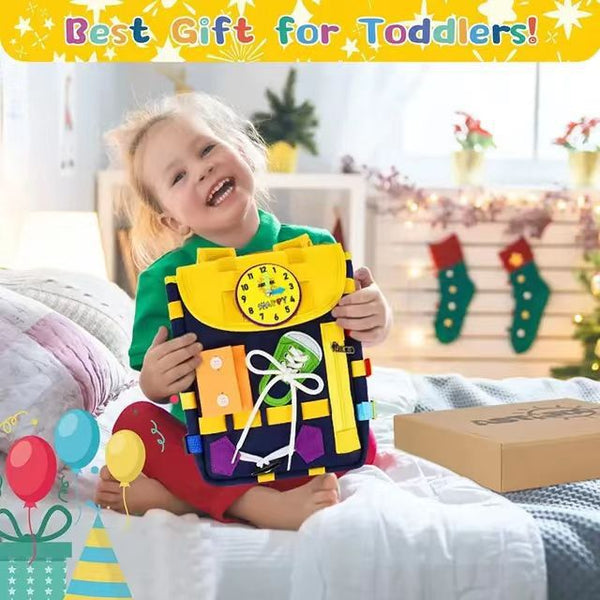
- Buttoning, zipping, and lacing frames
- Food preparation materials (cutting soft foods)
- Folding and organizing activities
What they develop: Fine motor skills, independence, order, confidence
Why they matter: Children gain practical competence in everyday tasks. A child who can pour juice, button a coat, or sweep up spills is developing both skills and confidence that translates to independence at home and school.
3. Mathematics Materials (Ages 3-6)
These toys make abstract math concepts concrete and understandable.
Examples:
- Golden beads (understanding quantity and decimal system)
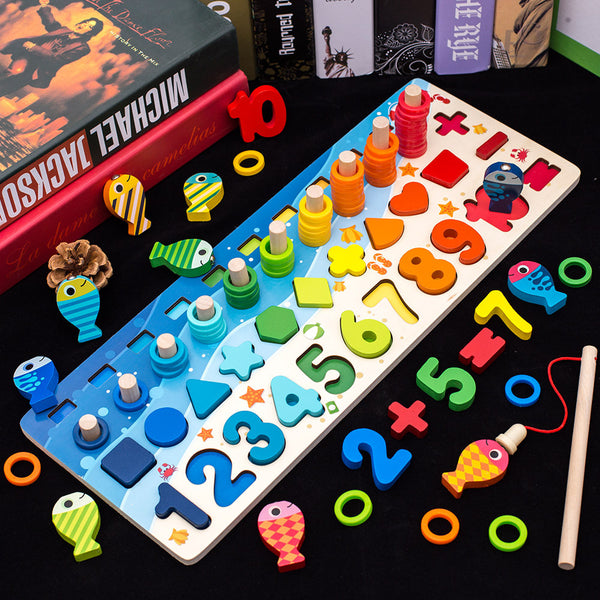
- Number rods (1-10 length progression)
- Spindle boxes (number recognition)
- Bead chains (skip counting and multiplication)
- Fraction circles (understanding parts of a whole)
What they develop: Number sense, mathematical thinking, concentration
Why they matter: By working with concrete materials before moving to abstract symbols, children develop genuine understanding of math concepts. They're not memorizing facts—they're building a foundation of mathematical thinking.
4. Language Materials (Ages 3-6)
These toys support the natural development of reading and writing.
Examples:
- Movable alphabet (letter recognition and word building)
- Sandpaper letters (tactile letter learning)
- Picture cards (vocabulary building)
- Reading books (leveled by difficulty)
- Writing materials (pencils, paper, tracing templates)
What they develop: Phonetic awareness, vocabulary, writing skills, reading comprehension
Why they matter: Montessori language materials support the natural progression from letter sounds to word building to reading. Children often learn to read earlier than in traditional settings because materials support the natural development of literacy.
5. Cultural and Scientific Materials (Ages 4-6+)
These toys introduce geography, history, science, and nature.
Examples:
- Continent puzzles (geography)
- Timeline materials (history)
- Botany and zoology cards (nature and animals)
- Periodic table materials (science)
- Cooking and gardening activities (practical science)
What they develop: Curiosity about the world, scientific thinking, cultural awareness, environmental appreciation
Why they matter: These materials satisfy children's natural curiosity about the world while introducing concepts in a hands-on, concrete way. A child doesn't just learn "Africa is a continent"—they hold a puzzle, trace its shape, and discover it physically.
How Montessori Toys Compare to Traditional Toys
Montessori Toys:
- ✅ Designed with specific developmental goals
- ✅ Self-correcting (child learns from natural consequences)
- ✅ Encourage deep concentration
- ✅ Made from natural materials
- ✅ Require active engagement
- ✅ Limited choices (reduces overwhelm)
- ✅ Grow with the child
- ✅ Develop independence
Example: A wooden bead maze isn't just "fun"—it develops fine motor skills, hand-eye coordination, and patience.
Traditional Toys:
- ❌ Designed primarily for entertainment
- ❌ May not provide feedback
- ❌ Can overstimulate with lights/sounds
- ❌ Often plastic with many options
- ❌ May encourage passive play
- ❌ Overwhelming number of choices
- ❌ Become boring quickly
- ❌ Often require adult direction
Example: A flashing electronic toy might entertain for 20 minutes but doesn't develop specific skills.
The Bottom Line:
Montessori toys aren't "better" for every situation. A child needs a mix of play types. But for developing real skills, building confidence, and fostering a love of learning, Montessori materials are scientifically proven to be highly effective.
How to Choose the Right Montessori Toy for Your Child
Step 1: Consider Your Child's Age and Development
Montessori materials are carefully sequenced. A toy that's perfect for a 3-year-old won't engage a 5-year-old. Look for materials designed for your child's current developmental stage.
Ages 2-3 (Toddler):
- Focus on sensorial exploration and practical life skills
- Fine motor development (pouring, transferring)
- Cause and effect understanding
- Examples: Pouring activities, color tablets, simple puzzles
Ages 3-4 (Early Preschool):
- Continue sensorial development
- Introduce language and early math
- Building independence
- Examples: Sandpaper letters, number rods, child-sized household tools
Ages 4-6 (Preschool to Kindergarten):
- Deepen language and math skills
- Introduce cultural/scientific concepts
- Reading and writing preparation
- Examples: Movable alphabet, golden beads, geography puzzles
Ages 6+ (Early Elementary):
- Reading and writing fluency
- Advanced mathematical thinking
- Project-based learning
- Examples: Advanced math materials, science experiments, cultural study
Step 2: Observe What Interests Your Child
The most effective Montessori learning happens when a child is interested. If your child loves building, start with construction-based materials. If they're fascinated by nature, begin with botany activities.
Watch for these signs of "ready" learners:
- Sustained attention on an activity
- Repeated interest in a specific area
- Questions about a topic
- Ability to sit still for extended periods
Step 3: Start With Foundational Materials
Don't buy everything at once. Start with core materials that develop essential skills:
- For fine motor: Practical life materials (pouring, transferring)
- For sensorial: Color tablets, texture boards
- For language: Sandpaper letters
- For math: Number rods, golden beads
These foundational materials support learning across all other areas.
Step 4: Prioritize Quality Over Quantity
One beautiful, high-quality Montessori toy is more valuable than ten plastic toys. Quality materials:
- Last through multiple children
- Invite engagement through aesthetics
- Support genuine learning
- Provide years of use
Budget wisely: You don't need to spend $200 on one toy. Many quality Montessori materials cost $15-50, and sets can be found at reasonable prices.
Step 5: Ensure Toys Are Authentic
Not every toy labeled "Montessori" is truly Montessori. Look for materials that:
- Have clear, single-purpose design
- Are made from natural materials
- Don't have extraneous features (sounds, lights, batteries)
- Match authentic Montessori design
- Are self-correcting
Red flags: Plastic Montessori toys, materials with "extra" features, toys that don't match the developmental purpose.
Where to Buy Quality Montessori Toys
Online Retailers:
- Nienhuis Montessori - Authentic, comprehensive selection (higher price point)
- Montessori Services - Quality materials, good prices
- Montessori Outlet - Budget-friendly options
- WonderKidsToy - Curated selection specifically for home use
- Amazon - Wide selection (be cautious of authenticity)
- Etsy - Handmade options from independent makers
Local Options:
- Montessori schools (often sell materials)
- Educational toy stores
- Specialty toy boutiques
- Used materials through parent groups
Budget Tips:
- Start small: Choose 1-2 key materials per month
- Look for sets: Often better value than individual items
- Buy secondhand: Well-made materials last through multiple children
- DIY options: Some Montessori activities can be created at home
- Prioritize: Core materials matter more than advanced materials
Frequently Asked Questions About Montessori Toys
Q1: Are Montessori toys expensive?
A: They range from $10-200 depending on the material. Quality doesn't always mean most expensive. A simple pouring activity (beans and containers) costs $15 but develops the same skills as a $200 golden bead set. Start with budget-friendly basics and invest in key items as you learn what your child engages with.
Q2: Will my child get bored with Montessori toys?
A: Not typically. Unlike toys with bright colors and built-in novelty, Montessori materials invite repeated use. A child might use a single material 50+ times, discovering new challenges each time. The lack of external stimulation means the toy itself remains interesting.
Q3: Are Montessori toys only for gifted children?
A: No. Montessori materials are designed for all children. They work because they match how children naturally develop, not because children need to be advanced. Children with learning differences often thrive with Montessori approaches.
Q4: Can I use Montessori toys if my child doesn't attend a Montessori school?
A: Absolutely. Montessori principles work at home too. You don't need to be a trained Montessori teacher to use these materials effectively—the toys are designed to be self-explanatory.
Q5: Are Montessori toys good for screen-free childhoods?
A: Yes. Montessori materials are specifically designed as alternatives to screen-based entertainment. They offer engaging, educational play without digital distraction.
Q6: How do I know if a toy is "authentic" Montessori?
A: Authentic Montessori toys should:
- Have a single, clear purpose
- Be made from natural materials
- Not require batteries or have electronic features
- Be self-correcting
- Support a specific developmental skill
- Be beautiful and inviting
If a toy needs a battery, has flashing lights, or serves multiple purposes, it's likely not authentic Montessori.
Q7: Can I mix Montessori toys with other educational toys?
A: Yes. Children benefit from diverse play. Montessori materials should be the foundation, but children also need open-ended play (blocks, art) and physical play. The combination is ideal.
Q8: What age should I start with Montessori toys?
A: You can start with simple sensorial and practical life materials as early as 18 months. However, 2-3 years old is when most families see the greatest benefit.
The Montessori Advantage: Real Skills for Real Life
Montessori toys work because they're based on how children actually develop. Dr. Montessori didn't invent these principles—she observed thousands of children and created materials that supported their natural learning process.
When you give your child quality Montessori materials, you're:
- ✅ Supporting real skill development
- ✅ Building genuine confidence
- ✅ Fostering independence
- ✅ Developing deep concentration
- ✅ Creating a love of learning
- ✅ Preparing for academic success
The beautiful part? Your child won't feel like they're "learning"—they'll feel like they're playing. That's the Montessori magic.
Ready to Start Your Montessori Journey?
Whether your child is 2 years old or 6 years old, there's a Montessori material designed to support their development right now.
Start small:
- ✓ Choose one foundational material
- ✓ Observe how your child engages with it
- ✓ Add materials that match their interests
- ✓ Watch your child's confidence and skills grow
Your child has an incredible capacity to learn and grow. With the right tools—Montessori toys—you're giving them the gift of independent, joyful learning.
Browse Our Montessori Toy CollectionDiscover high-quality, authentic Montessori materials selected specifically for home use. From practical life to sensorial to mathematics, find the perfect materials for your child's developmental stage.
Author:
Alok Gupta | WonderKidsToy Founder & Educational Toy Expert
Alok is passionate about helping parents find toys that truly support child development. With 10+ years of experience in educational toys, he's committed to making quality learning materials accessible to families everywhere