

Parent Guide • Imaginative Play • Screen-Free Creativity
Toys That Help Children Build Worlds, Tell Stories, and Explore Big Ideas
Imaginative play begins when a child turns an object, idea, or everyday experience into something new. A block becomes a phone. A blanket becomes a cave. A play kitchen becomes a busy restaurant. A group of figures becomes a family, a rescue team, or explorers on another planet. The best imaginative play toys give children enough structure to begin and enough freedom to decide what happens next.
Pretend play supports storytelling, language, creativity, social understanding, planning, flexible thinking, and emotional expression. It can be active and noisy or quiet and detailed. It can happen alone, beside another child, with siblings, or with an adult who follows the child’s ideas.
This guide compares pretend play sets, open-ended building materials, small-world toys, dress-up items, creative props, storytelling toys, and sensory materials. It also explains how to choose by age, avoid clutter, build an inviting play space, and help a story grow without taking control of it.
Explore educational toys for creative learning
Find hands-on toys for storytelling, construction, language, role play, problem-solving, and open-ended discovery.
Shop Educational ToysQuick Answer: What Are the Best Imaginative Play Toys?
The best imaginative play toys are open-ended enough for children to create different stories, roles, structures, and outcomes. Strong choices include pretend play sets, blocks and construction toys, small-world figures, dolls and animals, dress-up pieces, play food, vehicles, puppets, storytelling cards, art materials, loose parts, and sensory play tools. Choose toys that fit the child’s age, interests, available space, and ability to use the materials safely.
Table of Contents
Why Imaginative Play Matters
Imaginative play lets children practise making meaning. They use what they know about home, school, shops, vehicles, animals, helpers, stories, and relationships, then rearrange those ideas into a new situation. A child serving pretend soup is using memory, language, sequencing, and social understanding. A child building a rescue station is combining spatial planning with storytelling.
Language grows naturally because pretend play creates reasons to speak. Children name objects, explain rules, assign roles, negotiate what happens next, and use words connected to actions and feelings. Even children who play alone may narrate quietly or use sounds and gestures to organize the story.
Creative play also supports flexible thinking. A single prop can represent different things on different days. A cardboard tube might become a telescope, microphone, tunnel, or tool. When children change a plan, solve a problem in the story, or adapt to another player’s idea, they practise seeing more than one possibility.
Social and emotional learning can appear during role play. Children may care for a doll, comfort an animal, practise visiting a doctor, replay a confusing event, or explore what it feels like to be the teacher, parent, builder, pilot, or customer. Adults do not need to interpret every scene. Often, the value lies in having a safe space to experiment with roles and emotions.
Imaginative play can also deepen concentration. A child who is invested in a story may spend significant time arranging a scene, building a setting, finding the right prop, and revising what happens. The story gives purpose to the activity and connects different skills into one experience.
Best Types of Imaginative Play Toys
Pretend home and practical life sets
Play kitchens, food sets, cleaning tools, tool benches, tea sets, shopping baskets, and care routines connect to experiences children see every day. Familiar themes make it easy to begin a story. Choose props that invite action—mixing, serving, repairing, sorting, carrying, or organizing—rather than sets that perform the entire scene automatically.
Building and construction toys
Blocks and construction pieces are among the most flexible imaginative materials. Children can create houses, roads, castles, animal habitats, shops, vehicles, stages, and inventions. The structure becomes the setting for the story, and the need to build it adds spatial reasoning and problem-solving.
Small-world figures and environments
Animals, people, vehicles, trees, buildings, and simple landscape pieces help children create small worlds. A small-world setup can be realistic or fantastical. Begin with a manageable number of pieces and a clear container. Too many figures can make choosing and cleanup difficult.
Dolls, soft toys, and character figures
Characters create opportunities for caregiving, conversation, relationships, and story development. The most useful figures do not need many electronic features. Children can supply voices, feelings, actions, and identities. Include varied roles and experiences so children can create stories that feel broad and welcoming.
Dress-up and role-play props
Simple hats, bags, scarves, capes, aprons, safe tools, clipboards, and badges can transform a child into a chef, explorer, builder, shopkeeper, performer, doctor, or invented character. Open-ended fabrics are especially versatile. Check fit, visibility, fasteners, and movement safety.
Vehicles and transport play
Cars, trains, boats, construction vehicles, and other transport toys naturally invite routes, destinations, loading, rescue, travel, and community stories. Add blocks for roads and buildings, figures for passengers, or cards with simple destination ideas.
Puppets and storytelling tools
Puppets can make it easier for children to experiment with voices, feelings, humour, and conversation. Story cards, picture dice, felt-board pieces, and sequence cards offer prompts when a child wants help beginning. Use prompts as possibilities, not rules that limit the child’s version.
Art and maker materials
Paper, washable drawing tools, tape, child-safe scissors for the appropriate age, boxes, reusable stickers, and craft materials allow children to create props and settings. A child can make signs for a shop, tickets for a train, menus for a café, maps for an adventure, or costumes for characters.
Sensory materials and loose parts
Dough, sand tools, fabric pieces, large stones, wooden shapes, containers, and other safe loose parts can become food, treasure, landscapes, decorations, or building materials. Select items carefully for age and supervision needs, especially when younger children are present.
Turn building time into story time
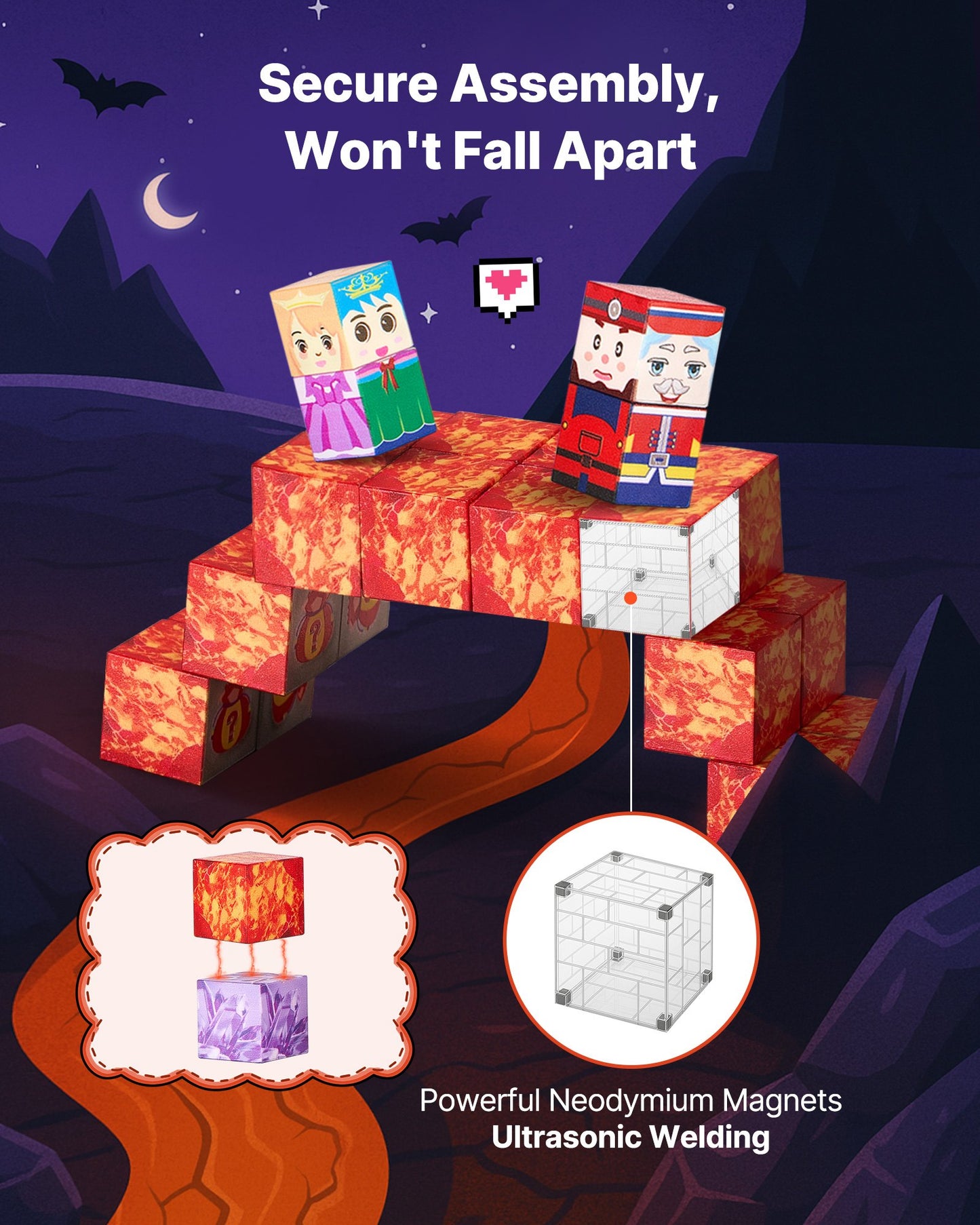
Blocks and construction toys can become homes, roads, stages, vehicles, habitats, and entire imaginative worlds.
Shop Building ToysHow to Choose Imaginative Play Toys by Age
Toddlers: imitation, simple props, and repeated routines
Toddlers often begin by copying familiar actions: feeding a doll, stirring a bowl, pushing a vehicle, talking on a toy phone, or putting an animal to bed. Choose sturdy pieces with simple functions and large parts. Short repeated scenes are meaningful at this age and do not need an elaborate plot.
Provide a few recognizable objects and model one action if needed. Then step back. A toddler may repeat the same action many times because repetition strengthens understanding and coordination.
Preschoolers: roles, dialogue, and growing story sequences
Preschoolers often create longer scenes with roles and simple problems. They may run a shop, prepare a meal, build a zoo, rescue an animal, or travel to an invented place. Pretend sets, dress-up props, blocks, figures, puppets, and vehicles can all support this stage.
Choose toys that can be combined. A building set can make the shop, figures can become customers, play food becomes the merchandise, and paper can become signs or money. Combining materials gives the child more control than relying on one large themed set.
Early school age: detailed worlds and cooperative planning
School-age children may enjoy more complex settings, character relationships, rules, maps, scripts, and construction. They can use STEM toys, robotics, building sets, craft supplies, and strategy elements inside imaginative play. A robot can become an explorer; a science kit can inspire a laboratory story; a construction set can become a working amusement park.
Shared play may involve negotiation. Children decide roles, resolve disagreements, and revise the story. Adults can support respectful turn-taking without deciding every detail.
Older children: design, performance, and world-building
Older children may move from traditional pretend sets toward model building, filmmaking, theatre, costume design, tabletop worlds, creative writing, robotics, and maker projects. Imagination has not disappeared; it has become more complex and specialized.
Choose materials that respect the child’s developing abilities. Detailed construction systems, art tools, coding projects, and performance props can support long-term creative goals when the child has ownership of the project.
Add language and storytelling to pretend play
Language learning toys can support vocabulary, sequencing, conversation, sound awareness, and story creation.
Shop Language Learning ToysHow to Create an Inviting Imaginative Play Space
A good imaginative play space does not require a large playroom. It needs accessible materials, enough floor or table space, and a system children can understand. Start with one theme or flexible basket rather than displaying every prop at once.
Use simple storage categories: people and animals, vehicles, food and home, dress-up, building pieces, art supplies, and fabrics. Clear bins, labelled baskets, or picture labels can help children find and restore materials.
Keep a basket of flexible props. Scarves, small boxes, cardboard tubes, clips appropriate for the child’s age, paper, tape, and reusable containers can fill gaps in almost any story. These inexpensive items often extend play more than adding another large themed set.
Leave some open space. When every surface is filled, children have nowhere to build a world. A floor mat, low table, or empty shelf can define the current scene and help protect an unfinished setup for later.
Rotate themes without removing all familiar favourites. You might place farm animals with blocks one week, vehicles with road pieces another week, or puppets with a small storytelling basket. Combining existing toys in a new way can make the collection feel fresh without constant purchasing.
Display books related to current interests. A book about construction, animals, community helpers, space, or food can add vocabulary and ideas that later appear in play. The book is not an assignment; it is another source of possibilities.
How Adults Can Join Without Taking Over
Begin by observing. Notice the child’s role, the problem in the story, and the rules already in place. Enter only when invited or when your participation could help the play continue.
Follow the child’s lead. If you are assigned the role of customer, animal doctor, passenger, or builder, ask what your character should do. Avoid immediately improving the plot, correcting realism, or introducing a lesson that replaces the child’s idea.
Use open prompts sparingly. Questions such as “What does the shop need?” “Where will the animals sleep?” or “How can the bridge reach the other side?” can extend thinking. Too many questions can feel like an interview, so leave room for action and silence.
Add vocabulary naturally. Name a tool, describe a position, or repeat a new word within the story. For example, “The mechanic is tightening the wheel,” or “The animals need a shelter.” Avoid stopping the play for a formal explanation unless the child asks.
Help solve material problems without solving the story. You might tape a box, find a cloth, stabilize a structure, or help write a sign. Then return control to the child.
Respect repetition. Children may replay the same doctor visit, rescue, restaurant order, or bedtime routine many times. Repetition can build confidence, language, and understanding. The story will often change when the child is ready.
When conflict arises between children, support negotiation. Clarify what each child wants, help them identify shared materials, and encourage possible solutions. Avoid assigning the entire game unless safety or fairness requires firmer guidance.
Parent Buying Checklist
First, identify the kind of imaginative play the child already enjoys. Do they imitate home routines, build environments, care for characters, move vehicles, perform stories, design costumes, or create art? Choose a toy that extends an existing interest rather than depending only on an age label.
Check flexibility. Ask how many different stories the toy could support and whether it combines with current materials. Blocks, figures, fabrics, vehicles, play food, art tools, and simple props often work across themes.
Consider size and storage. Large playsets can be engaging but may dominate the room and be difficult to rotate. Smaller collections in baskets may be easier to combine, carry, and restore. Choose what fits the actual home.
Review safety, durability, piece size, and supervision needs. Dress-up items should allow clear vision and movement. Containers and props should not have sharp edges. Loose parts must be appropriate for the youngest child who can access the space.
Look at who controls the action. Lights and sounds can be enjoyable, but the child should still make the important decisions. Avoid toys where pressing one button repeatedly replaces storytelling, construction, or role play.
Think about representation and inclusion. A varied collection of people, roles, homes, abilities, foods, and cultures can support wider stories. Choose respectful materials rather than stereotypes.
Finally, buy gradually. A few well-used materials can reveal what the child truly needs next. Adding one complementary set is often more useful than purchasing a large collection all at once.
Related Collections for Creative, Screen-Free Play
Explore Educational Toys, Building and Construction Toys, Language Learning Toys, Montessori Educational Toys, Problem-Solving Toys, and STEM Toys.
Frequently Asked Questions
What are imaginative play toys?
Imaginative play toys are materials children use to create roles, stories, settings, characters, and invented situations. They include pretend sets, blocks, figures, dress-up props, puppets, vehicles, art materials, and loose parts.
What age does pretend play begin?
Early pretend actions often appear in toddlerhood and become more complex through preschool and school-age years. Imagination continues into older childhood through design, performance, building, writing, games, and maker projects.
Are open-ended toys better for imagination?
Open-ended toys often have strong creative value because children decide how to use them. Realistic toys can also be helpful starting points. A balanced collection combines both.
How can I encourage pretend play without directing it?
Prepare a small invitation, observe, follow the child’s lead, accept the role offered, and use occasional open prompts. Avoid deciding the entire plot or correcting harmless imaginative details.
What toys support storytelling?
Puppets, figures, dolls, animals, building toys, vehicles, story cards, picture dice, dress-up props, and art materials can all support storytelling.
How many pretend play toys should be available?
There is no fixed number. A smaller, organized selection is often easier to combine and restore. Rotate themes while keeping versatile favourites available.
Can building toys count as pretend play toys?
Yes. Children use building toys to create settings, vehicles, tools, characters, and inventions. Construction and storytelling often strengthen each other.
What can I use instead of buying a large playset?
Boxes, scarves, paper, reusable containers, blocks, figures, safe household props, and art materials can create flexible pretend play at a lower cost and with less storage.
Continue Shopping by Learning Goal
Start with Educational Toys, then explore Educational Toys and STEM Toys.
Secure checkout • Free worldwide shipping • Review current product details