FULLY SCREEN-FREE
Building Blocks Toy Set for Kids: Creative Building, Focus & Problem-Solving
Parents often want a toy that holds a child’s attention without relying on passive entertainment, but many products look exciting online while giving little guidance about how children can actually use them. Building Blocks Toy Set for Kids offers a practical starting point for shared, hands-on play built around the product’s verified options.
Instead of promising instant results, this page explains what parents can reasonably expect, how to introduce the activity, what to confirm before purchase, and how to create repeat play opportunities. The goal is to help families choose confidently while keeping safety, readiness, and the exact selected variant in view.
This product is classified as Fully screen-free. Always compare that classification with the package instructions for the exact option delivered.
Why Parents May Choose This Building Toys
Purposeful Play
Creates a clear hands-on activity that parents can demonstrate and children can explore at their own pace.
Flexible Engagement
Works for short after-school sessions, quiet weekend play, family activity time, or a supervised learning corner.
Repeat-Play Potential
Children can revisit familiar actions, create new challenges, and explain their ideas instead of completing only one fixed task.
Parent-Friendly Guidance
Buying, setup, storage, care, and safety considerations are gathered in one place for easier decision-making.
The Parent Problem This Toy Can Help Address
It can be frustrating when children move quickly between activities, ask for more screen time, or lose interest because a toy has no obvious way to begin. Parents may also hesitate when a listing shows several options but does not explain how to select among them.
A better approach is to offer one manageable activity, demonstrate the first step, and let the child make meaningful choices. Building Blocks Toy Set for Kids can support that approach by giving families a physical play prompt that can be adapted to the child’s attention, confidence, and interests.
The solution is not to direct every move. Set up a safe space, introduce one feature, ask an open question, and allow time for experimentation. This keeps the adult involved without turning play into a test.
How Children Can Play and Learn
Begin by exploring the product together. Name visible parts, compare colors or shapes, and show how components are handled. If instructions are included, read them before use and keep them nearby for later reference.
Invite the child to predict what will happen, choose the next action, or describe a plan. During play, questions such as “What could you try next?”, “How did you decide?”, and “What changed?” encourage language and reasoning without demanding a correct answer.
Children may naturally practise hand-eye coordination, fine-motor control, visual attention, sequencing, patience, flexible thinking, and creative communication. The exact experience depends on the child and selected option; no toy can guarantee a developmental, academic, or therapeutic result.
For replay value, change one element at a time. Add a simple time-free challenge, take turns, create a story around the activity, sort pieces before beginning, or ask the child to teach the process back to an adult.
Available Options to Review
The current Shopify product record lists the following active configurations. Variant names identify ordering choices, but they do not prove unlisted materials, dimensions, accessories, functions, or age suitability.
- Bag 108pcs
- Storage Box 128pcs
- Storage Box 256pcs
- Storage Box 384pcs
- Extra Large Storage Box 70pcs
- Extra Large Storage Box 140pcs
- Extra Large Storage Box 210pcs
- Extra Large Base Box 210pcs
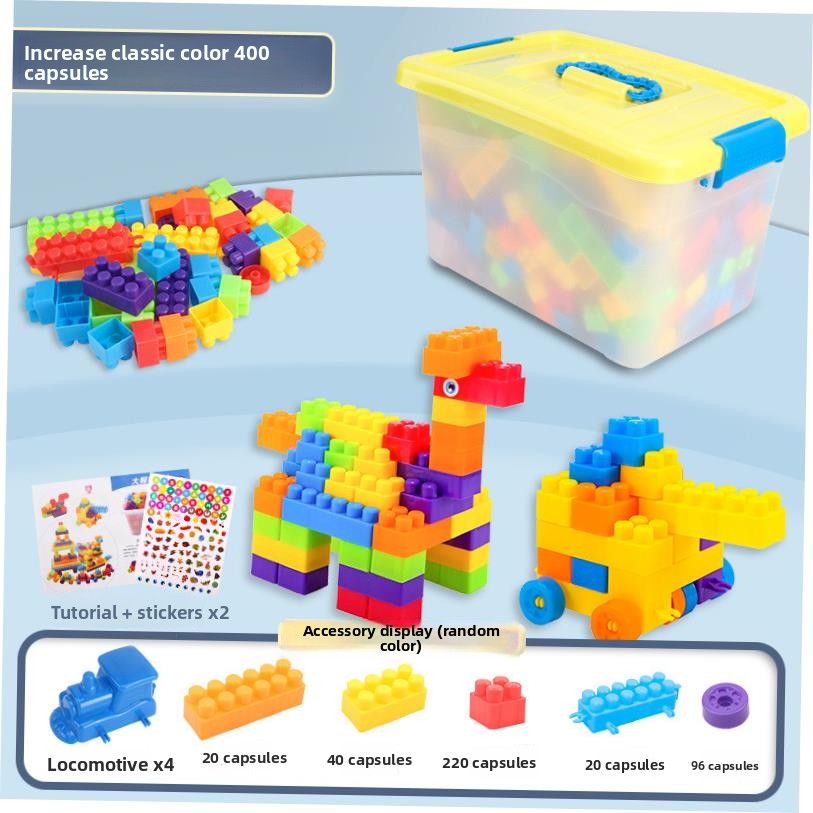
- Extra Large Storage Box 400pcs
Buying guidance: select the exact option first, then compare its matching image and physical package details. When variant wording is unclear, treat the package as the source of truth.
Screen Classification and Family Routine
Fully screen-free is the appropriate classification based on the current catalog information. If the product uses sound, lights, charging, or another electronic response, those features should support short interactive play rather than replace conversation and physical activity.
Parents can build a balanced routine by using the toy for a defined play period, talking about what happened, and following it with drawing, reading, building, pretend play, or outdoor movement. For a fully screen-free product, the same rhythm helps prevent cluttered, unfocused play.
Keep the activity accessible enough to invite use but store small, fragile, or electronic parts securely after the session.
Choosing for Your Child
Consider the child’s current interests, ability to follow basic safety directions, comfort with the listed pieces, and patience for the type of activity. A product can be appealing while still being a poor match for a child who mouths objects, becomes frustrated by tiny pieces, or needs more adult support than the family can provide at that moment.
Choose complexity for readiness, not simply age or the largest package. A smaller or simpler configuration may create a better first experience. Families can increase challenge later by adding rules, combining ideas, or inviting cooperative play.
For gifts, keep the product label and instructions attached so another caregiver can review warnings and setup information before play.
Safety, Care, and Storage
Inspect the product before every use. Stop using any component that is cracked, loose, sharp, swollen, frayed, leaking, unusually warm, or otherwise damaged. Keep small components away from children who mouth objects and follow every manufacturer warning.
Use a stable, well-lit play surface. If charging, batteries, cords, water, magnets, projectiles, or moving parts are involved, an adult should manage setup and remain close. Never modify the product or substitute power equipment unless the instructions explicitly allow it.
Follow the package cleaning method. Avoid soaking wooden pieces or allowing moisture into electronic areas. Count and store components in the original package or a labeled container after play.
Commonly Asked Questions by Parents
What is included with this product?
The exact contents depend on the selected option. Review the active variant name, matching product image, and package list before ordering.
Which option should I choose?
Choose the option whose listed configuration best matches your child’s interests, available play space, and ability to manage the pieces safely.
What age is this designed for?
Use the manufacturer’s age guidance printed on the physical package. Age suitability can vary by option, piece size, and the child’s individual readiness.
Does it require adult supervision?
Adult supervision is recommended, especially during first use and whenever the product includes small parts, moving pieces, cords, charging, sound, or electronic functions.
Is it a screen-free toy?
Use the screen classification shown in this description. Electronic sound or light features do not necessarily mean the product has a viewing screen.
What skills may children practise?
Depending on how it is used, play may support focus, coordination, planning, communication, creativity, and problem-solving. These are play opportunities, not guaranteed developmental outcomes.
Can siblings play together?
Yes, when the selected option provides enough materials and an adult sets simple turn-taking and cleanup expectations.
Is this suitable for independent play?
That depends on the child’s readiness and the exact option. Introduce the toy together first, then decide how much support is appropriate.
How should it be stored?
Keep all components together in the original package or a labeled container, stored dry and away from younger children who may mouth small pieces.
How should it be cleaned?
Follow the manufacturer’s care directions. Do not soak wooden or electronic parts, and keep moisture away from batteries, speakers, ports, and seams.
What should I inspect when it arrives?
Confirm the selected option, count visible components, check for damage, and verify the package instructions, warnings, materials, dimensions, and power details.
Can this be given as a gift?
It can be a thoughtful birthday, holiday, homeschool, or learning-play gift when the recipient’s age, interests, and supervision needs match the selected option.
What if a specification is not shown online?
Please review the product images or packaging for confirmation. Do not rely on assumptions about materials, dimensions, batteries, accessories, or age guidance.
Choose a Play Option That Fits Your Family
Review the active configuration, package guidance, and your child’s readiness, then make Building Blocks Toy Set for Kids part of a calm, hands-on play routine.